 MElkhateeb
➡️ Introduction
In every project, time is the one resource that cannot be recovered once lost. Whether you’re building software, launching a marketing campaign, or managing a construction project, your schedule determines success.
The most powerful scheduling technique to keep your project on track is the Critical Path Method (CPM) — the process of identifying the sequence of tasks that directly determines the project’s completion date.
Top 5 Project Management Software
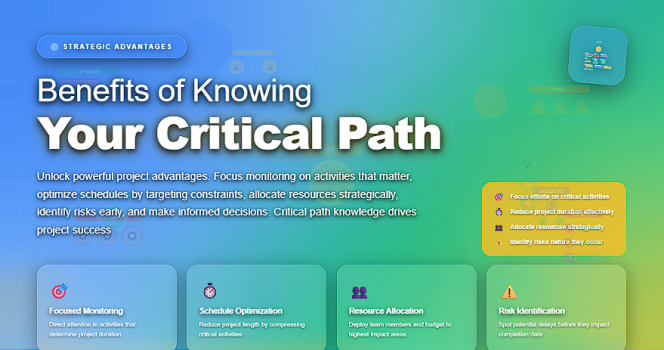
Knowing your critical path enables you to:
✔️ predict finish dates accurately
✔️ allocate resources more efficiently
✔️ prevent schedule slippage
✔️ understand which tasks cannot slip without impacting delivery
This article explains the core benefits of identifying your critical path and why it is essential for modern project managers.
✅ What Is the Critical Path?
The critical path is the longest chain of dependent activities in a project schedule.
It defines the shortest possible time in which a project can be completed.
Tasks on the critical path:
- have zero float/slack
- cannot be delayed without delaying the entire project
- require the highest level of monitoring
- receive priority for resources and attention
Understanding this path is essential for control, forecasting, and proactive decision-making.
✅ Benefits of Knowing Your Critical Path
Why CPM is a must-have tool for modern project managers.
| Benefit | Description |
|---|---|
| 1. Accurate Project Timelines | By mapping the longest sequence of tasks, CPM shows the earliest possible completion date and exposes constraints long before they become delays. |
| 2. Better Resource Allocation | When managers know which tasks cannot slip, they can strategically allocate skilled resources to activities that carry the highest risk. |
| 3. Early Detection of Delays | Any delay to a critical task indicates an immediate threat to the entire schedule, giving teams time to intervene quickly. |
| 4. Improved Decision-Making | CPM highlights the real drivers of project duration, enabling evidence-based decisions about priorities, trade-offs, and changes. |
| 5. Greater Schedule Transparency | Stakeholders clearly see which activities determine delivery dates, reducing confusion and improving communication. |
| 6. Ability to Fast-Track or Crash Strategically | If the project needs acceleration, CPM helps identify where to add resources or where parallel work is possible. |
| 7. Reduced Project Risk | Monitoring critical tasks minimizes schedule disruptions and strengthens the project’s resilience to unexpected events. |
✅ Why the Critical Path Matters More Today Than Ever
Modern projects are faster, more complex, and more interdependent than in the past.
Remote teams, digital transformation, agile–waterfall hybrids, and global supply chains mean delays can multiply quickly.
Knowing your critical path empowers you to:
✔️ operate proactively instead of reactively
✔️ focus your team’s attention on what truly drives delivery
✔️ prevent last-minute surprises
✔️ communicate clearly with executives and clients
✔️ maintain control even under shifting conditions
Project managers who master the critical path consistently deliver faster and with higher predictability.
⭐ Final Thoughts
The critical path is not just a scheduling technique —
it is a leadership tool.
It focuses attention, drives accountability, and gives project managers the power to foresee problems before they occur.
Great project managers don’t chase deadlines —
they manage the path that determines them.