 MElkhateeb
➡️ Introduction
Large projects often fail not because of lack of skill, but because of lack of structure.
When a project is too big, too complex, or too ambiguous, teams struggle with:
Top 5 Project Management Software
- unclear responsibilities
- shifting priorities
- unpredictable timelines
- hidden risks
- overwhelming workloads
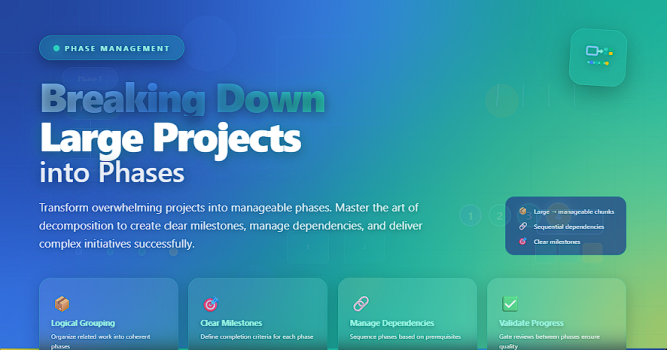
Breaking a large project into manageable, measurable, and sequenced phases is one of the most powerful techniques in project management.
This approach improves clarity, forecasting, coordination, risk visibility, and team performance.
Whether you manage construction, IT, marketing, operations, or transformation programs — phasing your project is essential for success.
This article explains why phasing is necessary, how to do it correctly, and includes a responsive schedule table you can embed anywhere.
✅ What Does It Mean to Break a Project into Phases?
Breaking a project into phases means dividing the work into logical groups of activities, each with a clear goal, timeline, deliverables, and approval points.
Most methodologies use phases:
- PMI → Initiation, Planning, Execution, Monitoring, Closing
- Waterfall → Requirements, Design, Build, Test, Deploy
- Agile → Iterations / Sprints
- Construction → Feasibility, Design, Procurement, Build, Handover
Phasing brings structure, predictability, and quality control.
✅ Benefits of Dividing Large Projects into Phases
✔️ Reduces complexity
✔️ Improves forecasting and scheduling
✔️ Makes budgeting more precise
✔️ Enables better stakeholder communication
✔️ Clear approval gates for decision-making
✔️ Simplifies risk management
✔️ Allows for staged resource allocation
✔️ Improves team focus
📌 Common Project Phases
A universal phase structure used in most large projects.
| Phase | Key Activities | Main Deliverables |
|---|---|---|
| 1. Initiation | Define objectives, identify stakeholders, business case creation. | Project Charter, Feasibility Decision. |
| 2. Planning | Create WBS, schedule, budget, risk plan, communication plan. | Project Management Plan. |
| 3. Execution | Task completion, team coordination, quality assurance, stakeholder engagement. | Completed Work Packages. |
| 4. Monitoring & Controlling | Tracking progress, managing changes, controlling scope, cost, quality, risks. | Performance Reports, Forecasts. |
| 5. Closing | Formal acceptance, documentation, lessons learned, release of resources. | Final Report, Closure Document. |
✅ How to Break Down a Large Project into Phases (Step-by-Step)
✔️ 1. Start with the Overall Project Objective
Understand the end goal clearly.
Ask:
- What will success look like?
- What must be produced?
- What work does this require?
Without a clear final objective, phases will become unclear and disconnected.
✔️ 2. Identify Major Workstreams
Divide the project into large functional areas such as:
- Technology
- Operations
- Marketing
- Procurement
- Training
- Compliance
These workstreams often become the basis for phase grouping.
✔️ 3. Convert Workstreams into Logical Phases
Each phase should represent a clear stage of progress, such as:
- Discovery
- Design
- Build
- Test
- Deploy
- Optimize
The key is sequencing — each phase moves you closer to the final deliverable.
✔️ 4. Define Clear Deliverables for Each Phase
Deliverables act as milestones and approval gates.
Examples:
- Requirements Document
- Prototype
- Training Manual
- Test Results
- Launch Plan
A phase without a clear deliverable becomes difficult to track and manage.
✔️ 5. Assign Roles, Responsibilities, and Resources
Each phase must have:
✔️ accountable leaders
✔️ supporting team members
✔️ allocated budgets
✔️ required tools & systems
This prevents resource conflicts between phases.
✔️ 6. Estimate Durations and Create the Schedule
Use:
- Gantt charts
- milestone charts
- Agile sprints
- phase gates
A realistic schedule prevents bottlenecks later.
✔️ 7. Define Risks for Each Phase
Large projects require phase-specific risk planning.
Examples:
- Phase 1: unclear requirements
- Phase 2: estimation errors
- Phase 3: technical failures
- Phase 4: regulatory delays
Risk visibility improves decision-making and control.
✔️ 8. Establish Entry and Exit Criteria
Before a phase starts → Entry Criteria
Before a phase closes → Exit Criteria
Examples:
- Entry: Budget approved, requirements signed off
- Exit: Testing completed, quality checks passed
This ensures discipline in transitions.
✔️ 9. Validate the Phase Breakdown With Stakeholders
Ask:
- Does this sequence make sense?
- Are phases too big or too small?
- Does each phase have a clear owner?
- Are approval points clearly defined?
Stakeholder validation prevents rework.
⭐ Best Practices for Breaking Down Large Projects
✔️ Use simple, easy-to-understand phase names
✔️ Make sure each phase has a measurable deliverable
✔️ Keep phases consistent across portfolios or programs
✔️ Use gating to improve quality control
✔️ Ensure early phases reduce uncertainty for later ones
✔️ Review and refine phases during execution
❌ Common Mistakes to Avoid
❌ Using too many phases → overcomplication
❌ Using too few phases → lack of clarity
❌ Not defining exit criteria → endless delays
❌ Ignoring cross-functional dependencies
❌ Skipping stakeholder validation
❌ Not aligning phases with budgeting cycles
⭐ Final Thoughts
Breaking down a large project into phases is one of the most effective tools a project manager can use.
It delivers structure, clarity, predictability, and control.
Large projects don’t succeed because they are big —
they succeed because they are broken into pieces everyone can understand and execute.