 MElkhateeb
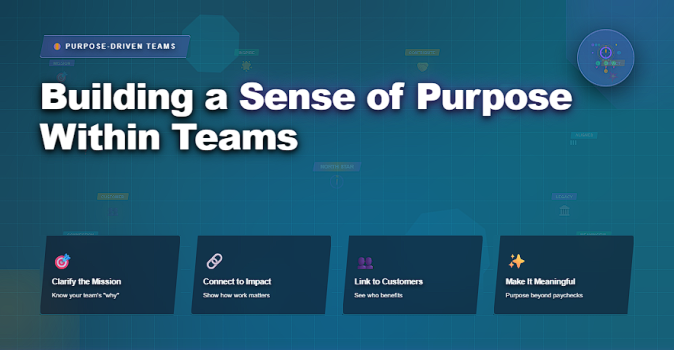
➡️ Introduction
Teams do not stay engaged because they are busy.
They stay engaged because their work means something.
Top 5 Project Management Software
In many organizations, people deliver tasks efficiently yet feel disconnected from the outcome. Over time, this disconnect reduces motivation, weakens accountability, and turns capable teams into passive executors.
A sense of purpose is not a slogan or a motivational speech.
It is the clear understanding of why the work matters, who it helps, and how each contribution fits into something bigger.
This article explains what purpose really means in teams, why it drives performance, and how leaders can intentionally build and sustain it.
✅ What “Purpose” Means in a Team Context
Purpose answers three simple but powerful questions:
✔️ Why does this work exist?
✔️ Who benefits from it?
✔️ Why does my role matter?
When teams cannot answer these questions, engagement becomes fragile — even if goals and KPIs are clear.
Purpose is not about inspiration alone.
It is about meaningful alignment between effort and impact.
✅ Why Purpose Drives Stronger Performance
Teams with a strong sense of purpose:
✔️ show higher ownership and accountability
✔️ make better decisions independently
✔️ persist through pressure and setbacks
✔️ collaborate more effectively
✔️ deliver higher-quality outcomes
Purpose does not replace structure — it amplifies it.
✅ Practical Ways to Build Team Purpose
Leadership actions that connect work to meaning.
| Leadership Action | What It Does | Why It Works |
|---|---|---|
| Connect Tasks to Outcomes | Shows who benefits from the work | Transforms tasks into contributions |
| Explain the “Why” Repeatedly | Reinforces meaning over time | Purpose fades without reinforcement |
| Link Individual Roles to the Bigger Picture | Clarifies personal impact | Builds ownership and pride |
| Share Real Impact Stories | Makes outcomes tangible | Emotional connection strengthens commitment |
| Involve the Team in Decisions | Creates shared responsibility | People support what they help shape |
✅ Purpose vs. Motivation: Understanding the Difference
Motivation answers how much energy people bring.
Purpose answers why they apply it.
Without purpose:
✔️ motivation depends on rewards
✔️ pressure becomes the main driver
✔️ engagement fluctuates
With purpose:
✔️ motivation becomes self-sustaining
✔️ accountability increases naturally
✔️ teams persist through difficulty
Purpose stabilizes motivation over time.
❌ Common Mistakes Leaders Make with Purpose
❌ treating purpose as a one-time message
❌ using vague or generic mission statements
❌ failing to connect daily work to outcomes
❌ assuming people “already know why”
❌ focusing only on deadlines and metrics
Purpose erodes quietly when leaders stop reinforcing it.
⭐ How Leaders Know Purpose Is Working
You will see:
✔️ proactive problem-solving
✔️ thoughtful decision-making
✔️ stronger collaboration
✔️ resilience during setbacks
✔️ pride in results
Purpose shows up in behavior, not slogans.
⭐ A Simple Purpose Check for Leaders
Ask yourself:
✔️ Can every team member explain why their work matters?
✔️ Do people see the impact of what they deliver?
✔️ Is the “why” discussed as often as the “what”?
If not, purpose is at risk.
⭐ Final Thoughts
Purpose is not created by speeches.
It is built through consistent leadership behavior.
When people understand why their work matters, they do not need constant supervision or pressure. They bring judgment, care, and commitment to what they do.
Great leaders do not just assign work.
They connect work to meaning — every day.