 MElkhateeb
➡️ Introduction
When teams grow, planning does not scale automatically.
Complexity does.
Top 5 Project Management Software
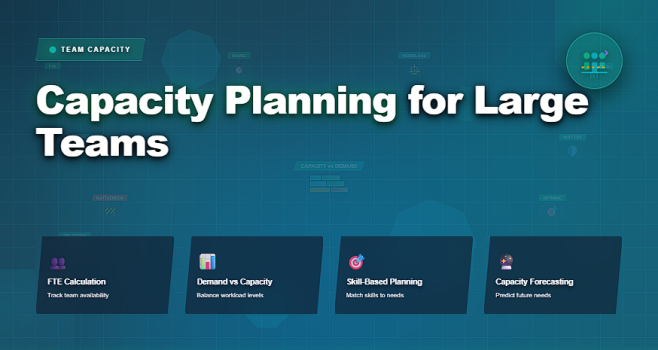
Capacity planning for large teams is not about counting headcount. It is about understanding how much work can truly be delivered — sustainably — across many people, roles, and dependencies.
Organizations often assume that adding more people increases output proportionally. In reality, coordination overhead, skill imbalance, and shared dependencies quickly erode that assumption.
Capacity planning is what separates organizations that deliver predictably at scale from those that constantly operate in crisis mode.
This article explains how capacity planning works for large teams, what makes it difficult, and how experienced leaders manage capacity without burning out people or missing commitments.
✅ What Capacity Planning Really Means at Scale
For large teams, capacity planning means:
✔️ understanding available effort across many roles
✔️ accounting for non-project work (meetings, support, admin)
✔️ recognizing skill constraints, not just availability
✔️ aligning workload with realistic throughput
✔️ adjusting plans as conditions change
Capacity is not theoretical time.
It is usable delivery capability.
✅ Why Capacity Planning Becomes Harder with Large Teams
As teams grow, several challenges appear:
✔️ work becomes highly interdependent
✔️ specialists become bottlenecks
✔️ communication overhead increases
✔️ priorities conflict across projects
✔️ utilization assumptions become unrealistic
Without structured capacity planning, large teams appear busy — yet deliver less than expected.
✅ Key Capacity Planning Elements
What must be managed to plan realistically at scale.
| Element | What It Represents | Why It Matters |
|---|---|---|
| Net Available Capacity | Time after meetings and overhead | Prevents overcommitment |
| Skill-Based Capacity | Who can do what work | Avoids specialist bottlenecks |
| Shared Resource Load | Demand across multiple projects | Makes conflicts visible early |
| Utilization Thresholds | Maximum sustainable workload | Protects performance and morale |
| Forecast Adjustments | Changes as reality evolves | Keeps plans credible |
✅ Common Capacity Planning Mistakes in Large Teams
❌ assuming 100% utilization
❌ treating all roles as interchangeable
❌ ignoring coordination overhead
❌ planning each project independently
❌ reacting to overload instead of preventing it
These mistakes compound quickly at scale.
⭐ Practical Capacity Planning Techniques That Work
Experienced leaders use techniques such as:
✔️ planning at role or skill-pool level
✔️ setting conservative utilization targets
✔️ limiting parallel initiatives
✔️ protecting scarce specialists
✔️ reviewing capacity monthly or quarterly
The goal is flow stability, not maximum busyness.
⭐ How Capacity Planning Supports On-Time Delivery
When capacity is planned realistically:
✔️ schedules become predictable
✔️ teams stop firefighting
✔️ priorities become clearer
✔️ trade-offs are made earlier
✔️ leadership confidence increases
Time saved comes from fewer surprises, not faster work.
⭐ Capacity Planning in Agile and Hybrid Environments
Capacity planning is not anti-Agile.
In Agile and hybrid setups, it supports:
✔️ stable velocity
✔️ realistic sprint commitments
✔️ sustainable pacing
✔️ credible release forecasts
Even adaptive environments need capacity awareness.
⭐ Final Thoughts
Capacity planning for large teams is not a spreadsheet exercise.
It is a leadership discipline.
Organizations that succeed at scale do not ask teams to do more.
They ask smarter questions about what is truly possible.
Strong capacity planning turns growth from a risk into an advantage —
by aligning ambition with reality, and plans with people.