
 MElkhateeb
➡️ Introduction
Every project manager eventually faces a moment when a project is heading toward failure. Deadlines slip, budgets rise, teams lose direction, and stakeholders lose confidence.
What separates good PMs from great PMs is how they respond when things fall apart.
Top 5 Project Management Software
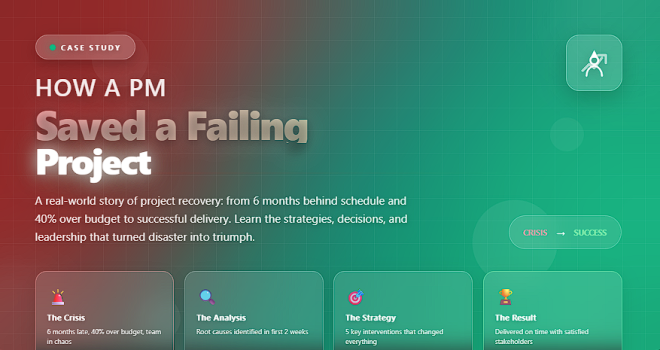
This case study breaks down a real-world scenario where a project manager successfully rescued a failing project. It highlights the exact actions taken, lessons learned, and strategies you can apply to your own projects — especially when recovery seems impossible.
✅ Background: The Project That Was Falling Apart
A mid-size software development initiative was launched with a 6-month timeline and a fixed budget. By month three:
- The schedule was 6 weeks behind
- UAT defect counts were 300% higher than expected
- Key developers were overworked
- Stakeholder trust was at an all-time low
The project was on the verge of cancellation. The PM was brought in to turn things around fast.
✅ Recovery Plan Breakdown
Actions the PM took to stabilize and recover the project.
| Action | Description | Impact |
|---|---|---|
| 1. Conducted a Rapid Health Check | Reviewed scope, timelines, team workload, risks, and quality metrics. | Identified root causes and stopped assumptions. |
| 2. Reset Expectations with Stakeholders | Held emergency meetings to communicate issues transparently. | Restored trust and aligned all parties on the real status. |
| 3. Rebuilt the Project Schedule | Created a new realistic timeline based on actual capacity. | Provided a feasible plan the team could commit to. |
| 4. Implemented Daily Stand-Ups | Introduced Agile routines to speed communication and reduce delays. | Increased accountability and surfaced issues early. |
| 5. Prioritized the Backlog | Removed low-value features that were slowing progress. | Reduced scope creep and refocused energy on essentials. |
| 6. Reallocated Resources | Shifted senior developers to critical tasks; added automation testers. | Improved productivity and reduced the defect rate. |
| 7. Strengthened Quality Control | Introduced code reviews, QA gates, and automated regression testing. | Lowered production defects drastically. |
| 8. Conducted Weekly Risk Reviews | Tracked emerging risks and implemented contingency plans. | Prevented hidden issues from spiraling. |
✅ Results: The Project Turnaround
After seven weeks of disciplined control and structured intervention:
- Schedule delays shrank from 6 weeks behind to 1 week behind
- Defect leakage dropped by 65%
- Team morale increased significantly
- Stakeholder confidence was restored
- The project launched successfully with high user adoption
The project went from nearly canceled to successfully delivered.
✅ Lessons Learned from the Recovery
✔️ 1. Transparency is more powerful than perfection
Stakeholders prefer bad news early — not late.
✔️ 2. Teams break when workloads break
Burnout is a major root cause of quality and schedule failures.
✔️ 3. Scope control is the PM’s strongest strategic weapon
Removing low-value requirements saved the entire project.
✔️ 4. Daily communication prevents weekly crises
Issues surfaced early become manageable.
✔️ 5. Quality improvements always accelerate progress
Better QA reduced rework, saving weeks of effort.
✔️ 6. Recovery requires fast decisions — not endless analysis
Action beats analysis paralysis.
✅ Best Practices for Handling Failing Projects
✔️ Reassess the situation immediately
✔️ Reset expectations transparently
✔️ Re-plan based on real capacity
✔️ Prioritize ruthlessly
✔️ Fix communication gaps
✔️ Strengthen QA
✔️ Track risks weekly
✔️ Celebrate quick wins to motivate the team
⭐ Final Thoughts
A failing project does not mean a failed project.
Every PM will face a crisis at some point — what matters is how effectively and confidently you respond. With the right actions, clear communication, and strong leadership, even severely troubled projects can be saved.
Great PMs don’t avoid problems —
they stabilize, simplify, and lead the project back to success.