 MElkhateeb
➡️ Introduction
Retail projects are notoriously vulnerable to schedule slippage.
Top 5 Project Management Software
Store openings, system rollouts, and merchandising changes operate under fixed dates driven by seasons, promotions, and customer demand. Missing a deadline is not an inconvenience — it is a direct revenue loss.
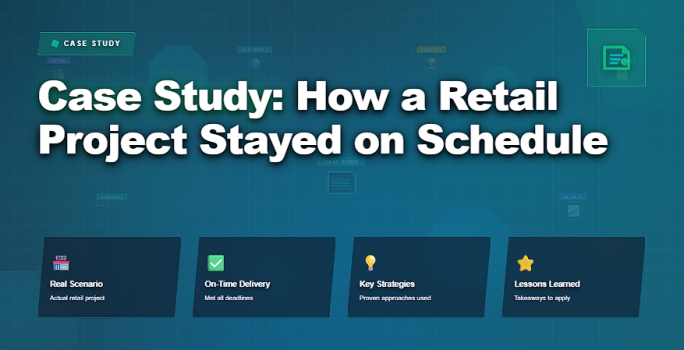
This case study examines how a mid-sized retail organization delivered a complex project on schedule, despite tight timelines, multiple dependencies, and frequent change pressure.
The focus is not on tools — but on planning discipline, decision-making, and execution habits that kept the project under control.
✅ Project Background
The project involved launching 20 new retail locations across multiple regions within a six-month window.
Key characteristics:
✔️ fixed opening dates
✔️ parallel workstreams (construction, IT, supply chain, HR)
✔️ external vendors and approvals
✔️ seasonal deadline that could not move
Failure to meet the schedule would directly impact sales targets and brand commitments.
✅ The Main Scheduling Risks
Early planning identified several high-risk areas:
✔️ overlapping construction and fit-out activities
✔️ long-lead procurement items
✔️ dependencies between store readiness and system installation
✔️ limited availability of specialized teams
✔️ frequent late requests from commercial stakeholders
The team knew that reactive planning would fail.
✅ Key Actions That Protected the Schedule
What the team did differently — and why it worked.
| Action | How It Was Applied | Result |
|---|---|---|
| Dependency Mapping | All cross-team dependencies mapped upfront | Fewer handoff delays |
| Fixed Milestone Dates | Store opening dates treated as non-negotiable | Clear prioritization decisions |
| Weekly Re-Forecasting | Plans updated weekly based on real progress | Early correction of slippage |
| Capacity-Based Planning | Work assigned based on availability, not urgency | Reduced overload and rework |
| Strict Change Control | All schedule changes logged and approved | Fewer disruptive surprises |
✅ How the Team Handled Schedule Pressure
Instead of compressing timelines blindly, the team:
✔️ challenged late scope requests
✔️ escalated trade-offs early
✔️ protected critical path activities
✔️ used contingency time intentionally
✔️ kept stakeholders informed weekly
Pressure was managed through decisions, not heroics.
✅ Results Achieved
By the end of the project:
✔️ all 20 stores opened on planned dates
✔️ no emergency overtime phases were required
✔️ vendor coordination issues decreased over time
✔️ stakeholder confidence improved
✔️ the schedule baseline remained credible
The project succeeded not by avoiding problems — but by surfacing them early.
⭐ Key Lessons for Project Managers
✔️ fixed dates require stronger planning discipline
✔️ dependency clarity matters more than detailed task lists
✔️ weekly re-forecasting prevents late surprises
✔️ capacity limits must be respected
✔️ schedule control is a leadership responsibility
⭐ Final Thoughts
This retail project stayed on schedule not because conditions were easy —
but because planning was treated as an ongoing control process.
Strong project managers do not rely on optimism or last-minute effort.
They create visibility, enforce discipline, and make trade-offs early.
Projects succeed not because schedules never change —
but because time is managed intentionally, every single week.