 MElkhateeb
➡️ Introduction
A Work Breakdown Structure (WBS) is the backbone of project planning.
When done correctly, it provides clarity, improves estimating accuracy, and creates a strong foundation for scheduling, budgeting, and control.
Top 5 Project Management Software
However, when a WBS is built incorrectly, even the best project plans begin to fail.
Many project delays, cost overruns, and scope issues can be traced back to basic mistakes made during WBS creation.
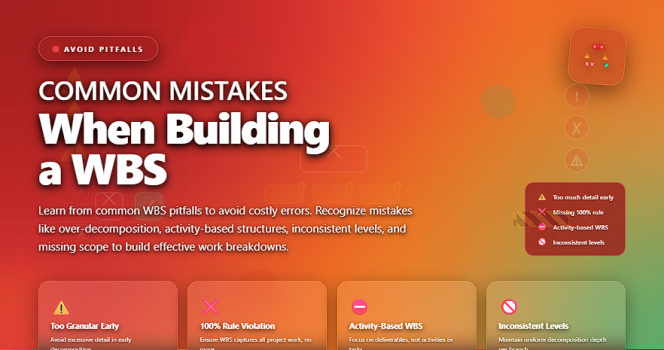
This article explains the most common WBS mistakes, why they happen, and how to avoid them—so your project starts on solid ground.
✅ Why the WBS Matters So Much
The WBS is not just a diagram—it is the structural blueprint of the project.
Everything depends on it:
- Schedule accuracy
- Cost estimation
- Resource planning
- Risk identification
- Progress tracking
A weak WBS creates confusion.
A strong WBS creates control.
✅ Common WBS Mistakes and How to Avoid Them
Frequent errors that weaken project planning and control.
| Mistake | Why It’s a Problem | How to Avoid It |
|---|---|---|
| Focusing on Activities Instead of Deliverables | Makes scope unclear and harder to control. | Define work in terms of tangible deliverables, not actions. |
| Breaking Work Down Too Much | Creates unnecessary complexity and micromanagement. | Stop decomposition when work can be estimated and assigned. |
| Not Breaking Work Down Enough | Leads to vague estimates and hidden tasks. | Ensure each work package is clear, measurable, and manageable. |
| Overlapping Work Packages | Creates confusion, duplication, and accountability gaps. | Apply the 100% Rule—no overlap between elements. |
| Ignoring the 100% Rule | Leaves scope gaps and missing deliverables. | Ensure the WBS covers 100% of project scope. |
| Creating the WBS Alone | Misses practical insights from the team. | Build the WBS collaboratively with subject-matter experts. |
| Mixing Phases and Deliverables | Results in an inconsistent structure. | Choose one decomposition logic and stay consistent. |
| Treating the WBS as Static | Makes the plan outdated as the project evolves. | Update the WBS when approved scope changes occur. |
✅ Detailed Explanation of Key WBS Mistakes
✔️ 1. Confusing Tasks with Deliverables
A WBS should describe what will be delivered, not how it will be done.
Tasks belong in the schedule, not the WBS.
✅ Correct: “Approved Design Document”
❌ Incorrect: “Design the system”
✔️ 2. Over-Decomposition
Breaking work into extremely small pieces increases complexity without adding control.
If it takes longer to manage a work package than to execute it, you’ve gone too far.
✔️ 3. Under-Decomposition
Large, vague work packages hide effort, cost, and risk.
If you can’t estimate, assign, or measure it clearly—it’s not decomposed enough.
✔️ 4. Violating the 100% Rule
The 100% Rule states that the WBS must include all project work—no more, no less.
Missing elements = hidden scope.
Overlapping elements = confusion.
✔️ 5. Building the WBS in Isolation
Project managers who build WBSs alone often miss real execution details.
The best WBSs are created with:
- technical experts
- team leads
- vendors or contractors (when appropriate)
✔️ 6. Inconsistent Structure
Mixing phases, tasks, deliverables, and roles in the same level creates confusion.
Choose one organizing principle and apply it consistently.
✔️ 7. Never Updating the WBS
Approved scope changes must be reflected in the WBS.
If the WBS is outdated, all downstream plans become unreliable.
✅ Best Practices for Building a Strong WBS
✔️ Start with the approved scope statement
✔️ Use deliverables, not activities
✔️ Apply the 100% Rule rigorously
✔️ Keep work packages measurable
✔️ Involve the whole team
✔️ Keep the structure logical and consistent
✔️ Use the WBS as the foundation for schedule, cost, and risk plans
⭐ Final Thoughts
Many project problems begin with a weak WBS.
Avoiding these common mistakes will dramatically improve your planning accuracy, execution discipline, and project control.
A strong WBS doesn’t just describe work —
it makes successful delivery possible.