 MElkhateeb
➡️ Introduction
Most schedule conflicts are not caused by missed tasks.
They are caused by misunderstood dependencies.
Top 5 Project Management Software
Stakeholders rarely struggle with the idea that work is connected. What they struggle with is how those connections affect dates, decisions, risk, and accountability. When dependencies are unclear, expectations drift, pressure increases, and surprises multiply.
Communicating dependencies is not a technical exercise.
It is a leadership responsibility.
This article explains why dependency communication often fails, what stakeholders actually need to understand, and how project managers can communicate dependencies clearly, credibly, and without unnecessary complexity.
✅ Why Dependencies Are Hard for Stakeholders to Understand
Stakeholders think in outcomes.
Dependencies live in execution logic.
Common gaps include:
✔️ dependencies explained as technical details
✔️ focus on task-level links instead of business impact
✔️ diagrams without interpretation
✔️ updates that mention delays without explaining cause
✔️ assumptions that stakeholders “already know”
The result is confusion, not alignment.
✅ What Stakeholders Really Need to Know About Dependencies
Stakeholders do not need every link in the schedule.
They need clarity on:
✔️ which dependencies affect key dates
✔️ where decisions or approvals are required
✔️ what could delay delivery
✔️ who owns each dependency
✔️ what happens if a dependency slips
Effective communication answers consequences, not mechanics.
✅ Communicating Dependencies Clearly
What stakeholders need to understand — and how to present it.
| Dependency Aspect | How to Explain It | Why It Matters to Stakeholders |
|---|---|---|
| Critical Dependencies | Highlight links affecting milestone dates | Directly impacts delivery commitments |
| External Dependencies | Clarify reliance on vendors or other teams | Indicates risk outside project control |
| Decision Dependencies | Explain where approvals unlock progress | Shows where leadership action is needed |
| Timing Sensitivity | Describe consequences of late starts or finishes | Prevents surprise delays |
| Ownership | Identify who controls each dependency | Clarifies accountability |
✅ Choosing the Right Level of Detail
Too much detail overwhelms.
Too little creates false confidence.
Project managers should:
✔️ communicate dependencies at milestone level
✔️ summarize task-level logic into impact statements
✔️ tailor depth based on stakeholder role
✔️ avoid exposing internal complexity unless needed
✔️ focus on what could change and why
Clarity comes from selective visibility, not full disclosure.
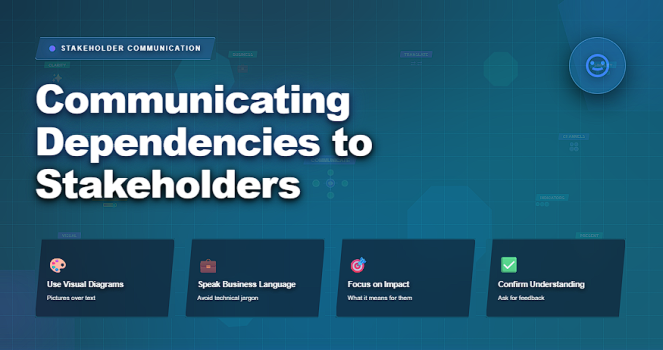
✅ Using Visuals Without Creating Confusion
Visuals help — if they are explained.
Best practices include:
✔️ using simple dependency maps
✔️ highlighting only critical paths
✔️ annotating diagrams with plain language
✔️ explaining “what happens if this slips”
✔️ updating visuals as conditions change
A diagram without narrative invites misinterpretation.
❌ Common Mistakes in Dependency Communication
❌ sharing full Gantt charts with executives
❌ explaining logic without business impact
❌ assuming silence means understanding
❌ reporting delays without explaining cause
❌ hiding dependency risks to avoid pressure
❌ overusing technical terminology
Poor communication turns dependencies into surprises.
⭐ Best Practices
✔️ communicate dependencies early and often
✔️ link dependencies to decisions and actions
✔️ keep explanations outcome-focused
✔️ make ownership visible
✔️ revisit dependency communication when plans change
✔️ treat clarity as a leadership skill
⭐ Final Thoughts
Dependencies are not a scheduling detail —
they are expectation drivers.
Strong project managers do not wait for dependencies to cause delays. They communicate them clearly, frame their impact honestly, and involve stakeholders before problems escalate.
Projects succeed not because dependencies disappear —
but because everyone understands them in time.