 MElkhateeb
➡️ Introduction
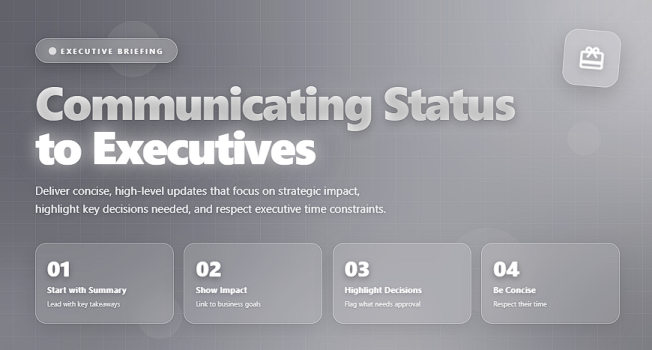
Executives want clarity — not complexity. They make decisions quickly, often with limited time and competing priorities. This is why communicating project status to executives requires a different strategy compared to updates for teams or stakeholders.
Top 5 Project Management Software
While team updates focus on tasks, roadblocks, and tactical details, executive communication must focus on strategic impact, risks that matter, budget alignment, and decisions required from leadership.
Mastering executive status reporting sets you apart as a confident, reliable project manager who can efficiently translate project reality into actionable business insights.
This article explains exactly what executives care about, how to structure your updates, and how to communicate with authority and clarity.
✅ What Executives Actually Want to Know
Executives care less about how you are doing the work and more about what the work means for the business.
They want:
- ✔️ A quick, honest snapshot of overall project health
- ✔️ Risks and issues that affect cost, timeline, or reputation
- ✔️ Whether the project is still aligned with business goals
- ✔️ What decisions they must make
- ✔️ Where their attention is needed
They expect accuracy, brevity, and confidence, not long explanations or technical jargon.
✅ Components of an Effective Executive Status Update
A structure that aligns with how executives think and decide.
| Section | What It Includes | Why Executives Care |
|---|---|---|
| Overall Project Health | Red / Yellow / Green status with one-sentence justification. | Gives instant clarity at a glance. |
| Key Achievements | Major milestones completed this period. | Shows progress and ROI. |
| Upcoming Milestones | Deadlines for the next period. | Helps anticipate resource or approval needs. |
| Top Risks and Issues | Only the critical risks affecting cost, time, or reputation. | Shows where the project is vulnerable. |
| Financial Snapshot | Budget spent, remaining, forecast, variance. | They manage money — keep it transparent. |
| Decisions Needed | Approvals, escalations, or support required. | They want to know where they must act. |
✅ How to Communicate Effectively with Executives
✔️ 1. Keep It High-Level
Executives don’t need detailed task updates — they need:
✔️ status
✔️ impacts
✔️ trends
✔️ decisions needed
If they want details, they will ask.
✔️ 2. Use Clear, Business-Centered Language
Avoid technical jargon.
Translate issues into business impact, such as:
- cost exposure
- timeline shifts
- strategic alignment
- customer impact
Executives think in outcomes, not tasks.
✔️ 3. Be Honest and Direct
Never hide or soften problems.
Executives prefer:
✔️ a clear problem
✔️ a proposed solution
✔️ an anticipated impact
Honesty = trust.
✔️ 4. Present Data Visually
Use:
✔️ simple dashboards
✔️ progress bars
✔️ milestone charts
✔️ heat maps
Executives process visuals faster than text.
✔️ 5. Focus on What Has Changed Since Last Update
Executives want movement, not repetition.
Highlight:
✔️ new risks
✔️ resolved issues
✔️ achieved milestones
✔️ changes in forecast
✔️ 6. Clearly State What You Need from Them
Examples:
- “We need approval to proceed with vendor onboarding.”
- “We need guidance on priority between Feature A and B.”
- “We require a decision regarding the budget variance.”
Executives value clarity and decisiveness.
✔️ 7. Prepare for Follow-Up Questions
Common executive questions include:
💬 “What is the root cause?”
💬 “What happens if we do nothing?”
💬 “What are the alternatives?”
💬 “Is this risk already escalating?”
Always be ready with concise, data-backed answers.
❌ Common Mistakes to Avoid
❌ providing too much detail
❌ hiding issues until they escalate
❌ presenting data without interpretation
❌ focusing only on technical details
❌ failing to connect updates to business goals
⭐ Best Practices
✔️ Use a fixed reporting format
✔️ Keep updates under 2–3 minutes when presenting live
✔️ Use RAG status for visibility
✔️ Highlight trends, not just snapshots
✔️ Make the call-to-action (decisions needed) unmistakably clear
⭐ Final Thoughts
The way you communicate status to executives directly influences trust, decision-making, and project success.
Mastering executive communication makes you appear confident, prepared, and strategically aligned — exactly what senior leadership expects from a strong project manager.
The best project managers don’t just report the status —
they help executives see the path forward.