 MElkhateeb
➡️ Introduction
Schedules reveal how a project thinks.
Top 5 Project Management Software
They show how work is sequenced, how uncertainty is handled, and how commitments are made. Agile and Waterfall schedules are not just different formats — they represent fundamentally different planning philosophies.
Waterfall schedules aim to predict and control the future.
Agile schedules aim to adapt as the future becomes clearer.
Understanding these differences is essential for project managers, especially in environments where both approaches coexist or where hybrid planning is required.
This article compares Agile and Waterfall schedules in practical terms — how they are built, how they behave under change, and when each approach is appropriate.
✅ What a Waterfall Schedule Is Designed to Do
A Waterfall schedule is a predictive, sequential plan.
It is designed to:
✔️ define the full scope upfront
✔️ sequence activities logically
✔️ estimate durations and dependencies
✔️ establish a baseline schedule
✔️ track variance against the plan
Waterfall schedules assume that most requirements are known early and that changes should be minimized to protect predictability.
✅ What an Agile Schedule Is Designed to Do
An Agile schedule is an adaptive, incremental forecast.
It is designed to:
✔️ deliver value in short cycles
✔️ plan in progressive levels of detail
✔️ respond quickly to learning and change
✔️ prioritize flow over task sequencing
✔️ forecast rather than commit long-term
Agile schedules accept uncertainty and manage it through frequent replanning instead of upfront prediction.
✅ How Scheduling Logic Differs Between Agile and Waterfall
The difference is not only in format — it is in intent.
Waterfall scheduling answers:
➡️ “What is the full sequence of work, and when will each part finish?”
Agile scheduling answers:
➡️ “Given our capacity, what is the most valuable work we can complete next?”
Both are valid — in different contexts.
✅ Comparing Agile and Waterfall Schedules
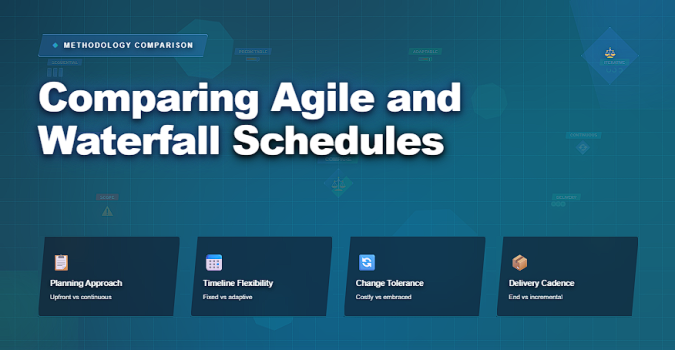
Two scheduling approaches built for different levels of certainty.
| Aspect | Waterfall Scheduling | Agile Scheduling |
|---|---|---|
| Planning Style | Upfront, detailed | Incremental and adaptive |
| Scope Definition | Fixed early | Evolving and prioritized |
| Schedule Detail | Task-level across full timeline | Detailed only for near-term work |
| Change Handling | Formal change control | Reprioritization and replanning |
| Progress Tracking | Planned vs actual dates | Completed increments and flow |
| Risk Exposure | Late discovery of issues | Early risk reduction through delivery |
| Forecast Confidence | High early confidence, degrades over time | Lower early confidence, improves over time |
✅ How Each Schedule Responds to Change
Waterfall schedules respond to change by:
✔️ assessing impact on baseline
✔️ updating dependencies and dates
✔️ approving changes formally
✔️ re-baselining when required
Agile schedules respond to change by:
✔️ reordering the backlog
✔️ adjusting future iterations
✔️ maintaining short-term commitments
✔️ updating forecasts incrementally
Neither approach avoids change —
they manage it differently.
✅ When Waterfall Scheduling Works Best
Waterfall schedules are effective when:
✔️ requirements are stable
✔️ technology is well understood
✔️ dependencies are fixed
✔️ regulatory or contractual deadlines dominate
✔️ change cost is extremely high
In these contexts, predictability outweighs adaptability.
✅ When Agile Scheduling Works Best
Agile schedules excel when:
✔️ requirements evolve
✔️ learning occurs during execution
✔️ customer feedback matters early
✔️ innovation is required
✔️ risk must be reduced quickly
Here, adaptability outweighs upfront precision.
❌ Common Mistakes When Comparing the Two
❌ assuming Agile means “no schedule”
❌ assuming Waterfall means “no flexibility”
❌ judging one approach by the other’s metrics
❌ forcing Agile teams into task-level Gantt charts
❌ using Waterfall schedules where uncertainty is high
The issue is rarely the method —
it is misalignment with context.
⭐ Best Practices
✔️ choose scheduling approach based on uncertainty
✔️ avoid one-size-fits-all planning
✔️ use hybrid models when needed
✔️ communicate confidence levels clearly
✔️ separate governance needs from execution needs
✔️ revisit scheduling assumptions regularly
⭐ Final Thoughts
Agile and Waterfall schedules are not competitors.
They are tools designed for different planning realities.
Strong project managers understand both, respect their differences, and apply them intentionally. The goal is not to follow a methodology — but to create schedules that support successful delivery.
Projects succeed not because schedules are perfect —
but because they are appropriate.