 MElkhateeb
➡️ Introduction
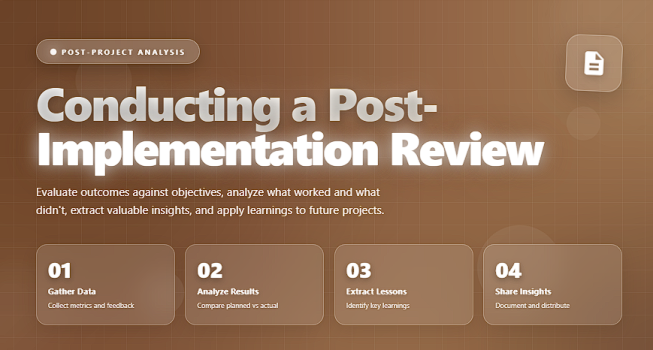
A project doesn’t end when deliverables are handed over. The real value comes from understanding what worked, what didn’t, and how future projects can improve.
This structured reflection is known as a Post-Implementation Review (PIR).
Top 5 Project Management Software
A well-executed PIR helps organizations:
✔️ identify strengths that can be repeated
✔️ uncover root causes of issues and failures
✔️ evaluate whether the project delivered its intended benefits
✔️ measure stakeholder satisfaction
✔️ build better processes, templates, and governance
PIRs turn experience into repeatable knowledge—the foundation of a continuously improving project management culture.
✅ What Is a Post-Implementation Review?
A Post-Implementation Review is a formal evaluation conducted after a project, phase, or major deliverable is completed.
It examines:
- whether objectives were achieved
- whether the solution works as intended
- how efficiently project processes were executed
- what challenges occurred and why
- what lessons can be applied to future work
Unlike a performance review, a PIR is not about blame—it’s about learning, improving, and strengthening organizational maturity.
✅ Why Post-Implementation Reviews Matter
PIRs are essential because they:
✔️ Capture lessons while memory is fresh
✔️ Improve future estimates, planning, and risk management
✔️ Identify process gaps, communication failures, and resource bottlenecks
✔️ Validate whether the project delivered its expected value
✔️ Increase transparency and accountability
Organizations that consistently conduct PIRs deliver projects faster, cheaper, and with fewer errors.
✅ When to Conduct a PIR
A PIR should be performed:
✔️ 4–12 weeks after implementation, allowing the solution to stabilize
✔️ when the team and stakeholders are available
✔️ after performance data has been collected
✔️ before transitioning insights into organizational knowledge
For large programs, PIRs may also be done after major phases or releases.
✅ How to Conduct a Post-Implementation Review (Step-by-Step)
✔️ 1. Define the PIR Objectives
Clarify the purpose of the review:
- evaluate project success
- assess process performance
- capture lessons learned
- improve future delivery
- validate expected benefits
Document these goals clearly before meeting with stakeholders.
✔️ 2. Gather Data and Evidence
Collect factual information, including:
- project scope changes
- schedule performance
- cost variance
- defect logs
- risk register updates
- stakeholder feedback
- user adoption metrics
- vendor performance reports
Data ensures the review is accurate and unbiased.
✔️ 3. Interview Stakeholders and Team Members
Speak with:
- project team members
- key stakeholders
- customers or end users
- sponsors or executives
- vendors or partners
Ask questions like:
➡️ What worked well?
➡️ What caused delays or rework?
➡️ What tools or processes were lacking?
➡️ What risks materialized and why?
➡️ What should we change next time?
✔️ 4. Evaluate Project Outcomes
Compare planned vs. actual performance:
- Were objectives met?
- Did the project deliver expected value?
- Are users satisfied with the outcome?
- Did performance metrics improve?
- Were benefits realized or are they still pending?
This step validates the success—or shortfalls—of the project.
✔️ 5. Analyze What Worked Well
Identify repeatable strengths such as:
✔️ strong communication processes
✔️ excellent vendor collaboration
✔️ effective risk mitigation strategies
✔️ accurate estimating practices
✔️ high team engagement
Documenting strengths helps reinforce successful behaviors.
✔️ 6. Analyze What Didn’t Work
Understand the root causes behind:
❌ delays
❌ cost overruns
❌ miscommunication
❌ quality issues
❌ stakeholder resistance
❌ scope misunderstandings
Use tools like the 5 Whys, Fishbone Diagram, or RCA (Root Cause Analysis).
✔️ 7. Document Lessons Learned
Lessons should be:
- specific
- actionable
- measurable
- transferable
- stored in a shared knowledge base
Good lessons prevent the same mistakes from repeating in future projects.
✔️ 8. Create an Action Plan for Improvement
Turn findings into concrete next steps, such as:
✔️ updating templates
✔️ adjusting estimation techniques
✔️ revising approval workflows
✔️ strengthening risk management processes
✔️ improving communication routines
✔️ enhancing vendor management practices
Assign owners and deadlines to ensure improvement actually happens.
✔️ 9. Share the PIR Findings
Communicate insights to:
- project team
- PMO
- department heads
- leadership
- future project managers
Sharing knowledge spreads improvement across the entire organization.
✔️ 10. Archive the PIR for Future Reference
Store the review where future teams can easily find it:
- PMO repository
- shared knowledge base
- internal wiki
- project documentation hub
Your future self—and other PMs—will thank you.
🛠️ Tools That Help With PIRs
Project managers commonly use:
✔️ Miro – visual retrospectives
✔️ Notion / Confluence – documentation and knowledge bases
✔️ Monday.com – reporting and dashboards
✔️ Excel / Google Sheets – PIR templates
✔️ Power BI – performance analytics
✔️ Zoom / Teams – stakeholder interviews
❌ Common Mistakes to Avoid
❌ Turning the PIR into a blame session
❌ Collecting opinions without data
❌ Waiting too long after implementation
❌ Not including end-user feedback
❌ Failing to assign responsibility for future improvements
❌ Completing a PIR but never acting on it
⭐ Best Practices
✔️ Keep discussions honest but respectful
✔️ Use a facilitator to avoid bias
✔️ Back insights with data, not opinions
✔️ Include both internal and external stakeholders
✔️ Turn lessons into improvements, not archives
✔️ Celebrate successes — not only mistakes
⭐ Final Thoughts
A Post-Implementation Review is one of the most powerful learning tools in project management.
It transforms every project—successful or challenging—into a source of insight that strengthens your organization’s capability.
Great project managers don’t just deliver projects.
They learn from them, improve from them, and elevate their teams with every lesson.