 MElkhateeb
➡️ Introduction
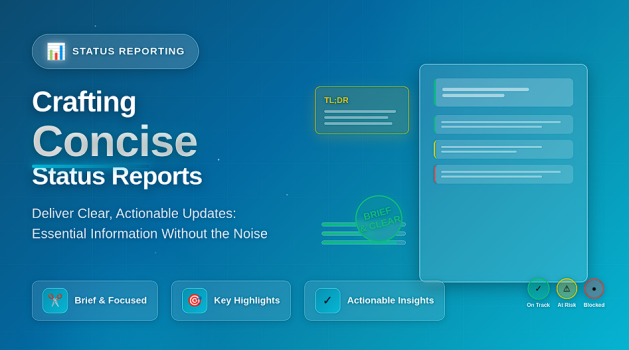
Project managers live and lead through communication — and nothing communicates progress better than a clear, concise status report.
A well-crafted status report bridges the gap between project teams and stakeholders, providing transparency, accountability, and direction.
Top 5 Project Management Software
But concise doesn’t mean incomplete. It means giving the right people the right information — fast. In this guide, you’ll learn how to create status reports that save time, strengthen trust, and keep your project moving smoothly.
✅ What Is a Project Status Report?
A status report is a short, structured update that summarizes key project information: what’s done, what’s next, and what needs attention.
It helps stakeholders quickly understand whether the project is on track, behind schedule, or at risk, without drowning them in details.
✅ Why Concise Reports Matter
✔️ Saves time for busy stakeholders.
✔️ Highlights priorities instead of noise.
✔️ Increases accountability through visibility.
✔️ Improves decision-making with accurate data.
✔️ Builds trust through consistency and clarity.
Too much data hides insights. A concise report spotlights what truly matters.
✅ Core Elements of a Concise Status Report
Essential sections that deliver clarity, alignment, and impact.
| Section | Description | Best Practice |
|---|---|---|
| 1. Project Overview | A quick summary of the project’s purpose and current phase. | Limit to 2–3 sentences that restate the goal and current focus. |
| 2. Overall Status | A color-coded snapshot of project health (Green / Yellow / Red). | Use visuals or icons to enhance readability at a glance. |
| 3. Key Highlights | Summarize recent achievements, milestones, or deliverables. | Use concise bullet points — focus on results, not activities. |
| 4. Upcoming Tasks | List what’s scheduled for the next reporting period. | Keep it short — 3–5 key items max, each with owners and due dates. |
| 5. Risks & Issues | Flag potential or active problems affecting progress. | Include severity, impact, and next step for each issue. |
| 6. Decisions & Actions | Document decisions made and upcoming approvals needed. | Tie each action to a responsible person and deadline. |
| 7. Summary & Next Steps | Close with a brief outlook or calls for stakeholder input. | End with one sentence about next milestones or focus areas. |
✅ How to Craft a Concise Status Report (Step-by-Step)
✔️ Step 1 – Know Your Audience: Adjust depth and format based on who reads it — executives want results, not process.
✔️ Step 2 – Focus on Value: Highlight only progress, issues, and decisions that affect success.
✔️ Step 3 – Visualize Data: Use charts, icons, or KPIs instead of paragraphs.
✔️ Step 4 – Be Consistent: Use the same format every week to build familiarity.
✔️ Step 5 – Add Context, Not Commentary: Explain what changed and why — but stay factual.
✔️ Step 6 – Deliver on Schedule: Send reports regularly, even if progress is minimal.
✅ Tools for Status Reporting
✔️ Monday.com – Automates dashboards and weekly summaries.
✔️ Miro – Visualizes progress updates for remote teams.
✔️ Smartsheet – Combines reporting with workflow automation.
✔️ Power BI / Tableau – Converts project metrics into visual insights.
✔️ Google Sheets / Excel – Simple and customizable for smaller teams.
✅ Common Mistakes to Avoid
❌ Overloading with raw data or technical jargon.
❌ Mixing personal opinions with factual updates.
❌ Skipping negative updates — honesty builds trust.
❌ Sending reports irregularly.
❌ Forgetting to summarize next actions or owner names.
✅ Best Practices
✔️ Keep it one page or less for standard reports.
✔️ Use visual signals like Green-Yellow-Red for clarity.
✔️ Group updates under “What’s Done,” “What’s Next,” and “At Risk.”
✔️ Ensure every section has an owner for follow-up.
✔️ Maintain the same format across all projects for consistency.
✅ Final Thoughts
Concise status reporting is a project manager’s storytelling skill — transforming raw progress into insight and direction.
When reports are structured, visual, and to the point, they empower faster decisions, reduce confusion, and strengthen leadership credibility.
A great status report doesn’t just inform — it drives action.