 MElkhateeb
➡️ Introduction
Collaboration does not happen because people sit in the same meeting or use the same tools.
It happens when the environment encourages shared ownership, trust, and open contribution.
Top 5 Project Management Software
Many teams claim to value collaboration, yet operate in silos. Information is guarded. Decisions are made in isolation. Problems surface late — if at all. These behaviors are rarely intentional. They are usually the result of unclear norms, misaligned incentives, and leadership signals.
A culture of collaboration is not a soft ideal.
It is a deliberate system of behaviors, structures, and leadership practices that directly affects performance.
This article explains what collaborative culture really means, why it matters, and how leaders can build it in practical, sustainable ways.
✅ What a Culture of Collaboration Really Is
A culture of collaboration exists when:
✔️ people share information proactively
✔️ responsibilities are owned collectively
✔️ disagreements are handled constructively
✔️ success is defined at the team level
✔️ learning is continuous and safe
Collaboration is not constant agreement.
It is working together toward shared outcomes, even when perspectives differ.
✅ Why Collaboration Drives Better Results
Collaborative teams:
✔️ surface risks earlier
✔️ solve problems faster
✔️ reduce duplication and rework
✔️ adapt more easily to change
✔️ sustain performance under pressure
In contrast, low-collaboration environments rely on heroics, escalation, and late fixes.
✅ Foundations of a Collaborative Culture
What enables collaboration to work in practice.
| Element | How It Shows Up | Why It Matters |
|---|---|---|
| Shared Goals | Clear, collective definition of success | Aligns effort across roles |
| Psychological Safety | People speak up without fear | Surfaces issues early |
| Open Communication | Transparent sharing of information | Prevents silos and surprises |
| Clear Accountability | Ownership without blame | Supports trust and follow-through |
| Mutual Respect | Valuing different perspectives | Strengthens problem-solving |
✅ The Leader’s Role in Enabling Collaboration
Collaboration is shaped more by leadership behavior than by tools.
Effective leaders:
✔️ model openness and listening
✔️ encourage cross-role problem-solving
✔️ reward team outcomes, not individual heroics
✔️ address silo behavior early
✔️ create space for constructive disagreement
What leaders tolerate becomes culture.
❌ Common Barriers to Collaboration
❌ unclear priorities
❌ competing incentives
❌ fear of blame
❌ excessive hierarchy
❌ information hoarding
Removing these barriers often improves collaboration faster than introducing new tools.
⭐ Practical Actions to Build Collaboration
Leaders can strengthen collaboration by:
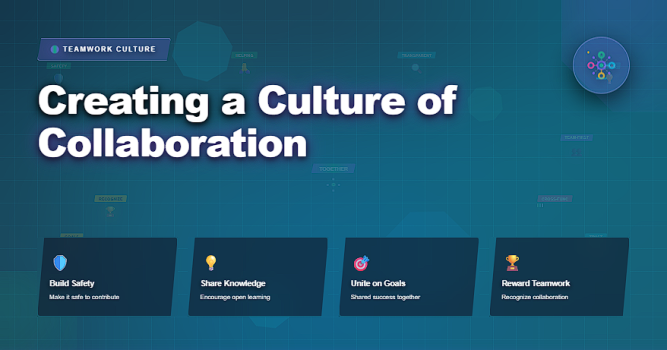
✔️ setting shared objectives explicitly
✔️ clarifying decision-making boundaries
✔️ normalizing feedback and questions
✔️ structuring meetings for contribution, not reporting
✔️ recognizing collaborative behavior publicly
Small structural changes produce lasting cultural shifts.
⭐ A Simple Collaboration Check for Leaders
Ask yourself:
✔️ Do people share bad news early?
✔️ Are decisions understood and supported?
✔️ Is success celebrated collectively?
If the answer is no, collaboration is constrained.
⭐ Final Thoughts
A culture of collaboration does not emerge from slogans or tools.
It is built through consistent leadership behavior, clear expectations, and shared accountability.
Teams collaborate best when trust replaces fear, clarity replaces assumptions, and leadership replaces control with enablement.
Collaboration is not a soft skill.
It is a core capability for sustainable performance.