 MElkhateeb
➡️ Introduction
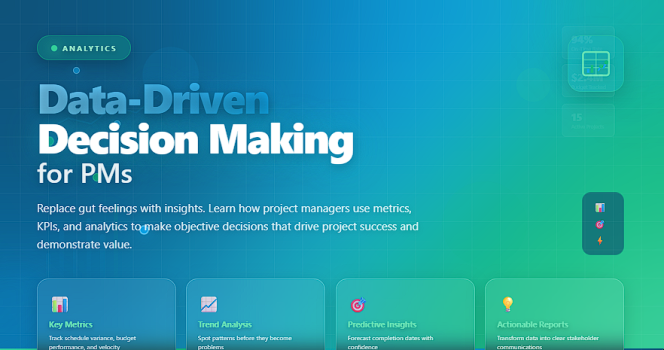
Modern project managers operate in an environment filled with complexity, uncertainty, and rapid change. Relying solely on intuition or past experience is no longer enough. To lead confidently and deliver predictable results, PMs must adopt data-driven decision making — a discipline that transforms raw data into actionable insights.
Top 5 Project Management Software
Whether you’re managing timelines, budgets, resources, risks, or stakeholder expectations, data empowers you to:
✔️ make faster, more accurate decisions
✔️ identify issues earlier
✔️ reduce project uncertainty
✔️ communicate with evidence, not opinion
✔️ forecast future project performance
This article explains how to integrate data into your daily leadership, what tools to use, and how to avoid common pitfalls — giving you a practical and strategic advantage as a project manager.
✅ What Is Data-Driven Decision Making in Project Management?
Data-driven decision making (DDDM) refers to using factual information, metrics, reports, and predictive analytics to guide project decisions, rather than relying solely on assumptions or subjective judgment.
In project management, this includes analyzing:
- schedule performance
- cost performance
- resource utilization
- risk trends
- quality indicators
- stakeholder behavior
- team productivity
- change requests and impacts
When used consistently, data becomes a strategic asset that enables PMs to manage with clarity and confidence.
✅ Benefits of Data-Driven Decision Making
How data strengthens project outcomes on every front.
| Benefit | Description | Impact on Project |
|---|---|---|
| Improved Accuracy | Decisions are based on evidence, not assumptions. | Reduces errors and unexpected issues. |
| Early Issue Detection | Trends and variances appear sooner. | Allows faster corrective action. |
| Better Forecasting | Data reveals future schedule or cost impacts. | Improves planning and resource allocation. |
| Stakeholder Confidence | Updates are backed by measurable insights. | Enhances trust and transparency. |
| Stronger Risk Management | Exposure can be quantified and tracked. | Prevents risks from escalating. |
✅ Key Data Sources Every PM Should Use
Project managers should rely on multiple streams of information, including:
✔️ 1. Schedule Data
- task progress
- milestone completion
- resource availability
- critical path performance
✔️ 2. Cost & Financial Data
- actual vs planned spend
- cost variance
- labor rates
- forecasting models
✔️ 3. Resource Utilization
- workloads
- availability
- productivity metrics
✔️ 4. Risk & Issue Logs
- probability trends
- impact scoring
- risk exposure over time
✔️ 5. Quality Metrics
- defect counts
- rework volume
- testing performance
✔️ 6. Stakeholder Feedback
- satisfaction levels
- communication patterns
- engagement quality
Using these sources together enables holistic decision-making.
✅ How to Implement Data-Driven Decision Making (Step-by-Step)
✔️ Step 1: Define What You Need to Measure
Choose KPIs aligned with project goals, such as:
- schedule variance
- cost variance
- resource utilization rate
- earned value
- defect density
Clarity in measurement = clarity in decisions.
✔️ Step 2: Establish Reliable Data Collection Methods
Use standardized tools and protocols:
- project dashboards
- timesheets
- automated status reporting
- digital forms
- PMIS systems
Consistency is essential.
✔️ Step 3: Analyze Trends, Not Just Numbers
Great PMs don’t look at data once — they track movement over time.
Trend-based insights include:
- burn rate acceleration
- rising defect rate
- declining team velocity
- repeated missed milestones
Patterns reveal the truth behind performance.
✔️ Step 4: Visualize Data for Better Understanding
Use charts, dashboards, and heat maps to translate complexity into clarity.
Tools like:
- Power BI
- Tableau
- Monday.com dashboards
- Google Data Studio
- Excel visualization
Visual data speeds up executive decision-making.
✔️ Step 5: Use Predictive Analytics to Forecast Outcomes
Predictive models help PMs:
- estimate final cost
- predict schedule delays
- anticipate resource shortages
- identify emerging risks
This elevates PMs from reactive managers to strategic leaders.
✔️ Step 6: Turn Insights into Decisions
Data is only valuable when it leads to action.
Examples:
- reallocate resources to protect the schedule
- adjust baselines based on actual performance
- escalate risks backed by measurable evidence
- optimize workload distribution
✔️ Step 7: Communicate Findings Clearly
Executives and stakeholders want concise, visual reporting.
Use:
- dashboards
- bullet summaries
- clear variance explanations
- trend commentary
Data + story = powerful influence.
❌ Common Pitfalls in Data-Driven Decision Making
PMs must avoid these traps:
❌ relying on incomplete or inconsistent data
❌ analysis paralysis
❌ measuring too many KPIs
❌ ignoring qualitative insights
❌ using data without context
❌ manipulating data to match expectations
Balance data with professional judgment.
⭐ Best Practices for PMs
✔️ Build a dashboard for daily project visibility
✔️ Standardize data collection across teams
✔️ Automate manual reporting where possible
✔️ Focus on KPIs that truly matter
✔️ Validate data before making decisions
✔️ Combine quantitative and qualitative insights
⭐ Final Thoughts
Data-driven project managers are more confident, more accurate, and more respected.
By integrating data into every major decision, PMs can:
- predict problems
- justify actions
- increase transparency
- deliver projects more reliably
Great project managers don’t guess —
they decide with evidence.