
 MElkhateeb
➡️ Introduction
Effective delegation is one of the most powerful skills a project manager can master — yet it is also one of the hardest.
Delegation is not about “handing off work”; it’s about assigning ownership, empowering your team, and ensuring tasks are completed by the most capable person.
Top 5 Project Management Software
When done well, delegation increases productivity, develops team skills, reduces bottlenecks, and allows the project manager to focus on strategic work instead of firefighting.
✅ Why Delegation Matters
✔️ Prevents burnout and workload overload
✔️ Develops team capability and confidence
✔️ Improves speed and efficiency
✔️ Ensures the right tasks are handled by the right people
✔️ Strengthens collaboration and trust
Delegation is not a weakness — it’s a mark of strong leadership.
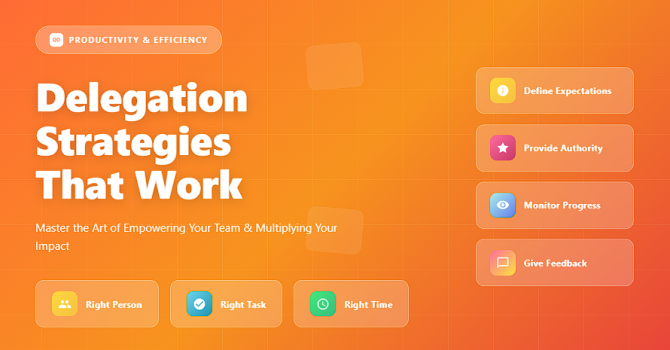
✅ Delegation Strategies That Work
Practical approaches to assign tasks, empower others, and deliver results.
| Delegation Strategy | Why It Works | How to Apply It |
|---|---|---|
| 1. Delegate Based on Strengths | People perform better when tasks match their skills. | Assign tasks aligned with expertise, not just availability. |
| 2. Set Clear Expectations | Removes ambiguity and reduces rework. | Define scope, success criteria, deadlines, and ownership upfront. |
| 3. Give Authority, Not Just Tasks | Boosts confidence and reduces dependency on the PM. | Empower team members with decision rights related to their tasks. |
| 4. Provide Resources and Support | Ensures people have what they need to succeed. | Share tools, templates, budgets, and clarify support channels. |
| 5. Use Checkpoints, Not Micromanagement | Maintains control without damaging morale. | Set periodic health checks instead of monitoring every move. |
| 6. Offer Constructive Feedback | Improves quality and skill growth. | Give timely, specific, and actionable feedback during the work. |
| 7. Celebrate Ownership | Reinforces accountability and increases motivation. | Acknowledge contributions publicly during meetings or stand-ups. |
✅ Steps for Effective Delegation
✔️ Step 1 – Identify the right tasks to delegate
Routine, time-consuming, or development-focused tasks are ideal.
✔️ Step 2 – Choose the best person for the task
Match skills, interest, and availability.
✔️ Step 3 – Communicate clearly
Explain what needs to be done, why it matters, and what success looks like.
✔️ Step 4 – Transfer authority
Allow the person to make decisions within the task boundaries.
✔️ Step 5 – Support without interfering
Provide guidance only when needed.
✔️ Step 6 – Monitor progress
Use checkpoints and dashboards instead of micromanagement.
✔️ Step 7 – Review and refine
Assess the result and refine delegation methods for next time.
✅ Tools That Improve Delegation
✔️ Monday.com – Assign tasks, track progress, and automate reminders.
✔️ Smartsheet – Create task ownership dashboards and resource views.
✔️ Miro – Map delegation workflows visually.
✔️ ClickUp / Asana – Allows workload distribution and ownership tracking.
✔️ Power BI – Helps analyze performance and workload trends.
✅ Common Delegation Mistakes to Avoid
❌ Delegating without context
❌ Taking tasks back too quickly
❌ Assigning tasks to the wrong person
❌ Failing to follow up
❌ Providing unclear or incomplete instructions
❌ Delegating tasks but not authority
✅ Best Practices
✔️ Document delegated tasks in your communication plan
✔️ Encourage autonomy and flexibility
✔️ Recognize both effort and results
✔️ Build trust through transparency
✔️ Use delegation as a coaching opportunity
✅ Final Thoughts
Delegation is not about reducing your workload — it’s about increasing your team’s capability and project performance.
When you delegate with clarity, trust, and structure, your team grows stronger, faster, and more confident.
Great project managers don’t do everything themselves — they enable others to shine.