 MElkhateeb
➡️ Introduction
Leadership and management are often used as interchangeable terms.
They are not the same — and confusing them creates real problems.
Top 5 Project Management Software
Organizations fail when they are well managed but poorly led, or visionary but operationally weak. Projects stall when managers focus only on control, or leaders ignore execution discipline.
Understanding the difference between leadership and management is not an academic exercise.
It directly affects decision-making, team performance, change adoption, and results.
This article explains the real difference between leadership and management, how each shows up in daily work, and why successful organizations — and projects — need both.
✅ Why the Difference Matters
Leadership and management serve different purposes:
✔️ management creates stability and order
✔️ leadership creates direction and momentum
✔️ management focuses on execution
✔️ leadership focuses on meaning and alignment
When one replaces the other, imbalance appears.
✅ What Management Really Is
Management is about structure and reliability.
Managers:
✔️ plan and organize work
✔️ assign tasks and responsibilities
✔️ monitor performance
✔️ control risks and issues
✔️ ensure consistency and compliance
Management answers the question:
“How will the work get done correctly?”
Without management, execution becomes chaotic.
✅ What Leadership Really Is
Leadership is about direction and influence.
Leaders:
✔️ define vision and purpose
✔️ align people around goals
✔️ inspire commitment
✔️ navigate uncertainty
✔️ drive change
Leadership answers the question:
“Why does this work matter, and where are we going?”
Without leadership, work loses meaning.
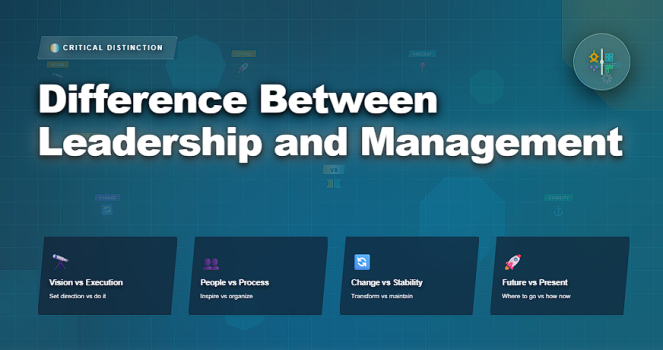
✅ Leadership vs. Management: Practical Comparison
How each role contributes to organizational success.
| Aspect | Leadership | Management |
|---|---|---|
| Primary Focus | Vision and direction | Execution and control |
| Key Question | Why and where? | How and when? |
| Approach to Change | Drives and embraces change | Stabilizes and manages change |
| People Interaction | Influences and inspires | Directs and coordinates |
| Success Measure | Alignment and commitment | Efficiency and consistency |
✅ Leadership and Management in Project Environments
In projects:
✔️ management ensures scope, time, and cost are controlled
✔️ leadership keeps teams motivated during uncertainty
✔️ management tracks progress
✔️ leadership resolves ambiguity and conflict
✔️ management enforces process
✔️ leadership adapts direction
Projects need both — simultaneously.
❌ Common Misunderstandings
❌ leaders don’t need management skills
❌ managers cannot be leaders
❌ leadership replaces discipline
❌ management kills creativity
In reality, the most effective professionals combine both mindsets.
⭐ How Strong Leaders and Managers Balance Both Roles
High-performing leaders:
✔️ lead with vision
✔️ manage with discipline
✔️ switch modes based on context
✔️ know when to inspire and when to control
✔️ understand that balance changes over time
Balance is situational, not fixed.
⭐ A Simple Self-Check
Ask yourself:
✔️ Am I providing clear direction and reliable execution?
✔️ Do my decisions balance people and process?
✔️ Am I leading change or only managing tasks?
The answers reveal where development is needed.
⭐ Final Thoughts
Leadership and management are not rivals.
They are complementary forces.
Management without leadership creates efficiency without purpose.
Leadership without management creates vision without results.
Great organizations — and great projects — succeed when both work together, intentionally and consistently.