 MElkhateeb
➡️ Introduction
No matter how well you plan, every project eventually faces challenges that require higher-level attention — delayed deliverables, resource conflicts, or unresolved decisions.
That’s where escalation paths come in.
Top 5 Project Management Software
An escalation path defines how and when an issue should move from the project team to higher levels of management or stakeholders for resolution.
It ensures that problems are addressed quickly, transparently, and by the right people — before they grow into crises.
✅ What Is an Escalation Path?
An escalation path is a structured process for reporting and resolving issues that cannot be handled at the current level of authority.
It clarifies:
✔️ Who should be informed when an issue arises.
✔️ What criteria trigger escalation.
✔️ How the escalation will be communicated.
✔️ What time frame applies for each escalation level.
Think of it as a safety valve — designed not to bypass team control, but to ensure the right decisions are made at the right level.
✅ Why Escalation Paths Matter
✔️ Maintain control and accountability.
✔️ Prevent small issues from escalating into major risks.
✔️ Provide clear ownership for problem-solving.
✔️ Strengthen communication across the project hierarchy.
✔️ Build stakeholder trust through structured transparency.
Without an escalation path, confusion replaces clarity — and delays multiply.
✅ Common Escalation Levels in Projects
How issues move through authority levels for timely resolution.
| Level | Responsible Role | Typical Issue Type | Expected Resolution Time |
|---|---|---|---|
| Level 1 | Project Manager or Team Lead | Minor risks, task delays, internal coordination problems. | Within 24–48 hours. |
| Level 2 | Project Sponsor or Department Manager | Resource shortages, budget adjustments, or inter-department conflicts. | Within 3–5 business days. |
| Level 3 | Steering Committee or Executive Leadership | Strategic alignment issues, contractual disputes, or major risks. | Within 1–2 weeks. |
✅ Steps to Create an Effective Escalation Path
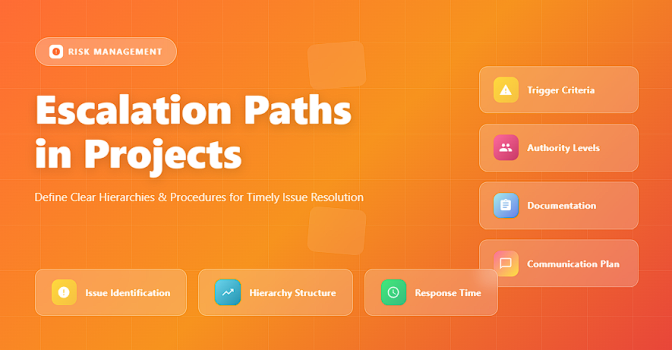
✔️ Step 1 – Define Authority Levels: Determine who can solve which types of issues.
✔️ Step 2 – Establish Escalation Criteria: Decide what triggers escalation — cost variance, delays, or quality deviations.
✔️ Step 3 – Set Response Timelines: Assign realistic turnaround times for each escalation tier.
✔️ Step 4 – Communicate the Path: Include the escalation process in the project communication plan.
✔️ Step 5 – Document Everything: Track issues, actions, and resolutions for accountability.
✔️ Step 6 – Review and Improve: After closure, assess how effectively escalations were handled.
✅ Tools That Help Manage Escalations
✔️ Monday.com – Automates alerts and visualizes escalation workflows.
✔️ Smartsheet – Tracks issue ownership, deadlines, and resolution status.
✔️ Miro – Visualizes escalation flowcharts for project onboarding.
✔️ Power BI – Displays trends in issue frequency or escalation delays.
✔️ Jira / ClickUp – Ideal for tracking and auto-assigning issue escalations.
✅ Common Mistakes to Avoid
❌ Treating escalation as a sign of failure instead of process control.
❌ Escalating too early without internal review.
❌ Delaying escalation due to fear of blame.
❌ Missing documentation or unclear communication.
❌ Escalating without solutions or supporting data.
✅ Best Practices
✔️ Keep escalation data-driven and factual, not emotional.
✔️ Maintain transparency when issues move up the chain.
✔️ Escalate with recommendations, not just problems.
✔️ Ensure escalation decisions are tracked and communicated to all stakeholders.
✔️ Treat every escalation as a learning opportunity for process improvement.
✅ Final Thoughts
Escalation paths don’t replace team problem-solving — they strengthen it.
By defining a clear, structured process, you create a culture where challenges are resolved efficiently, not ignored.
Strong escalation paths turn pressure into progress — and problems into decisions.