 MElkhateeb
➡️ Introduction
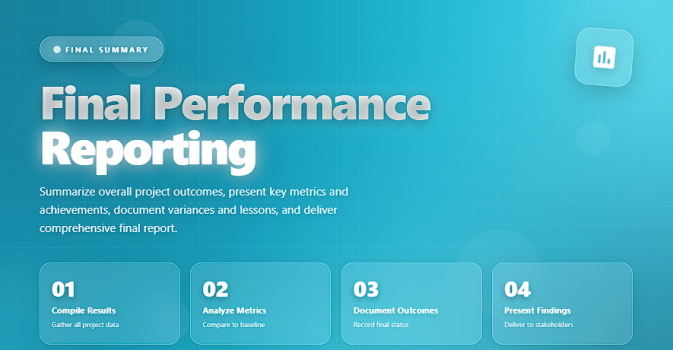
Final performance reporting is the last major analytical step before a project is officially closed. It consolidates the project’s results, compares performance against baselines, highlights variances, captures achievements, and documents lessons for future work.
Top 5 Project Management Software
A strong final performance report gives executives clarity, supports organizational learning, and ensures compliance with governance standards. Poor reporting, on the other hand, leads to recurring mistakes, lack of transparency, and weak decision-making for the next portfolio cycle.
This guide explains what a final performance report includes, how to create it, and why it matters, using project management best practices recognized globally.
✅ What Is Final Performance Reporting?
Final performance reporting is the process of summarizing and evaluating how the project performed in terms of:
✔️ scope
✔️ schedule
✔️ cost
✔️ quality
✔️ risks
✔️ resources
✔️ stakeholder engagement
It compares planned vs. actual performance, presents the final deliverables, and documents key outcomes, successes, and challenges.
This report becomes a permanent historical record that strengthens organizational maturity.
✅ Why Final Performance Reporting Matters
A well-prepared final performance report:
✔️ gives executives confidence that the project achieved its objectives
✔️ ensures transparency in budget and resource usage
✔️ documents successes and failures for future teams
✔️ contributes to portfolio-level decision making
✔️ supports compliance and audit requirements
✔️ protects the project manager through documented evidence
✔️ increases knowledge maturity across the organization
It is both a communication tool and a strategic document.
✅ Key Components of a Final Performance Report
A complete breakdown of what your final project report must include.
| Component | Description | Purpose |
|---|---|---|
| Project Summary | High-level overview of objectives, scope, deliverables, and outcomes. | Sets the context for the final evaluation. |
| Performance vs. Baselines | Comparison of planned vs. actual scope, time, and cost. | Shows how well the project met expectations. |
| Quality Results | Quality metrics, testing results, audits, and defect summaries. | Confirms deliverable reliability and standards compliance. |
| Risk & Issue Outcomes | How major risks and issues were handled. | Improves future risk management practices. |
| Resource Performance | Team contributions, utilization, overtime, and bottlenecks. | Supports workforce planning for future projects. |
| Stakeholder Satisfaction | Feedback from customers, sponsors, and end-users. | Measures perceived project success. |
| Financial Summary | Final costs, variances, savings, and ROI where applicable. | Ensures transparency and financial accuracy. |
| Lessons Learned | Successes, failures, and insights for future projects. | Strengthens organizational maturity. |
| Recommendations | Proposals for improvements or future work. | Guides portfolio leaders in decision-making. |
✅ How to Create a Final Performance Report (Step-by-Step)
Here is a complete, actionable process you can follow:
✔️ 1. Consolidate All Project Data
Collect:
- schedules
- budgets
- KPIs
- quality metrics
- risk logs
- change requests
- resource usage
- stakeholder feedback
This ensures your report is comprehensive and evidence-based.
✔️ 2. Compare Final Results Against Baselines
Key comparisons include:
✔️ Planned vs actual timeline
✔️ Budgeted vs actual cost
✔️ Original vs delivered scope
✔️ Expected vs actual quality results
Avoid interpretation until you have collected the full data set.
✔️ 3. Analyze Variances and Root Causes
Explain the reasons behind:
✔️ delays
✔️ cost overruns or savings
✔️ scope shifts
✔️ quality issues
✔️ resource constraints
This analysis is where senior leaders find the most value.
✔️ 4. Document Final Deliverable Quality
Include:
✔️ testing results
✔️ defect logs
✔️ audit outcomes
✔️ acceptance criteria compliance
Quality performance is a major element of project success.
✔️ 5. Evaluate Risk and Issue Handling
Summarize:
✔️ which risks occurred
✔️ how issues were managed
✔️ impact of mitigation strategies
✔️ remaining residual risks
✔️ what worked and what didn’t
This feeds into organizational learning.
✔️ 6. Capture Stakeholder Satisfaction
Gather input from:
✔️ customers
✔️ end users
✔️ sponsors
✔️ team members
Highlight approval ratings, concerns, and key insights.
✔️ 7. Summarize Financial Performance
Include:
✔️ final total cost
✔️ cost variances
✔️ additional funding requests
✔️ cost savings
✔️ return on investment (if applicable)
Financial clarity is essential for audits and governance.
✔️ 8. Write Lessons Learned and Recommendations
Provide practical insights that future teams can use.
Examples:
- Improve requirement clarity
- Strengthen vendor escalation process
- Increase buffer time for testing
- Use a more flexible communication framework
Recommendations should be specific and actionable.
✔️ 9. Present the Report to Executives
Deliver the report through:
✔️ a structured presentation
✔️ dashboards
✔️ summary slides
✔️ supporting annexes
Focus on high-value insights, not raw data.
⭐ Best Practices for Final Performance Reporting
✔️ Keep the report factual and objective
✔️ Use visual dashboards where possible
✔️ Highlight both successes and failures
✔️ Include supporting evidence
✔️ Share credit with the team
✔️ Store the report in a central repository
⭐ Final Thoughts
A final performance report is not just an administrative task — it is the culmination of project knowledge, a tool for strategic improvement, and the final communication of what the project achieved.
Strong teams finish their projects.
Great teams document their results and help future teams succeed.