 MElkhateeb
➡️ Introduction
Forecasting resource demand is one of the most critical responsibilities in project management.
It determines whether your team can meet deadlines, absorb scope changes, and deliver quality work without unnecessary pressure.
Top 5 Project Management Software
When resource demand is not forecasted correctly, teams face predictable problems:
overload, delays, poor quality, budget overruns, and constant fire-fighting.
Accurate forecasting doesn’t just improve efficiency — it protects your team, stabilizes delivery, and strengthens decision-making at every level of the project.
This article explains what resource demand forecasting is, why it matters, and how project managers can apply practical, data-driven methods to predict future workload with confidence.
✅ What Is Resource Demand Forecasting?
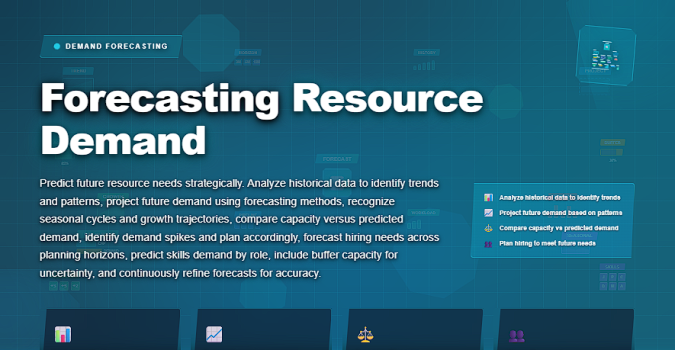
Resource demand forecasting is the process of predicting the skills, capacity, and time a project will require in the future.
A good forecast answers questions like:
✔️ How many hours will each phase require?
✔️ Which roles or skills will be needed most?
✔️ Do we have enough people for upcoming work?
✔️ When will workload peak?
✔️ When will we need extra support or contractors?
✔️ How will scope changes affect resource needs?
Forecasting allows PMs to act before problems appear instead of reacting after teams become overloaded.
✅ Why Forecasting Resource Demand Is Essential
Strong forecasting helps project managers:
✔️ prevent overload and burnout
✔️ allocate resources efficiently
✔️ plan hiring and outsourcing realistically
✔️ avoid underutilization and waste
✔️ create accurate timelines
✔️ anticipate skill gaps
✔️ negotiate expectations with stakeholders
Poor forecasting is one of the leading causes of schedule slips and cost overruns. Good forecasting, on the other hand, transforms resource management from reactive to strategic.
📌 Common Challenges in Forecasting Resource Demand
Even experienced PMs face difficulty predicting workload because of:
✔️ fluctuating task durations
✔️ unclear or evolving requirements
✔️ inaccurate estimations
✔️ untracked historical data
✔️ multiple parallel projects
✔️ skill shortages or bottlenecks
✔️ unplanned work (bugs, support, rework)
Most forecasting issues come from lack of structured data, not lack of effort.
That’s why spreadsheets — when designed properly — are extremely powerful for resource prediction.
📌 How to Build a Forecasting System Using Spreadsheets
A reliable forecasting model usually includes:
1️⃣ Work Breakdown Structure (WBS) Effort Estimates
Break tasks into measurable components.
2️⃣ Skill-Based Assignments
Identify which roles or competencies each task requires.
3️⃣ Capacity Data
Document weekly hours and availability for each resource.
4️⃣ Historical Performance Data
Use past projects to refine estimates and predict patterns.
5️⃣ Utilization Targets
Most teams perform best at 70–85% utilization, not 100%.
6️⃣ Scenario Modeling
Run what-if simulations (scope increases, delays, shifts).
When combined, these elements create a powerful prediction engine inside a spreadsheet.
➡️ Practical Strategies for Forecasting Resource Demand
✅ Early Indicators Your Forecast Is Inaccurate
You may need to adjust your forecasting approach if you notice:
✔️ frequent timeline slips
✔️ repeated resource shortages
✔️ constant reallocation of tasks
✔️ teams working overtime to catch up
✔️ multiple dependencies stuck on the same person
✔️ budget consumption ahead of schedule
These are symptoms of missing or inaccurate workload predictions.
✅ Practical Actions Project Managers Should Take
✔️ Include the team in estimation discussions
✔️ Use real historical data, not guesswork
✔️ Track forecast vs. actual performance
✔️ Identify peak workload periods in advance
✔️ Add buffers to high-risk tasks
✔️ Update forecasts continuously, not once
Accurate forecasting is a living process — not a one-time document.
❌ Common Mistakes That Lead to Forecasting Failure
❌ assuming every resource has 100% availability
❌ ignoring unexpected work (support, bugs, reviews)
❌ relying purely on expert judgment without data
❌ planning based on ideal conditions
❌ failing to consider skill-specific constraints
❌ not updating forecasts as scope evolves
⭐ Best Practices
✔️ forecast demand by skill type, not headcount
✔️ integrate workload tracking with capacity sheets
✔️ maintain a centralized forecasting dashboard
✔️ use conditional formatting to highlight risks
✔️ run scenario models before approving scope changes
✔️ review resource demand weekly
⭐ Final Thoughts
Forecasting resource demand is not about predicting the future perfectly — it’s about creating a reliable, data-driven foundation for capacity planning and workload management.
Teams perform best when forecasting:
✔️ prevents overload
✔️ identifies bottlenecks early
✔️ informs hiring and outsourcing decisions
✔️ supports accurate timelines and budgets
✔️ enables sustainable, high-quality delivery
Great project managers don’t wait for problems to appear.
They foresee them, prepare for them, and guide their teams with clarity.