 MElkhateeb
➡️ Introduction
Feedback fails when it creates tension instead of progress.
Top 5 Project Management Software
Most leaders understand the importance of feedback, yet many avoid it because past attempts caused defensiveness, discomfort, or conflict. The issue is rarely what is said — it is how and when it is delivered.
Constructive feedback is not about pointing out mistakes.
It is about helping people succeed without damaging trust.
This article explains how leaders can give constructive feedback that improves performance while preserving relationships and momentum.
✅ Why Feedback Often Creates Friction
Feedback becomes difficult when:
✔️ it feels personal rather than behavioral
✔️ it comes as a surprise
✔️ it lacks context or purpose
✔️ it focuses only on what went wrong
✔️ it is delivered under pressure
Friction is a signal that feedback was experienced as judgment, not support.
✅ What “Constructive” Feedback Really Means
Constructive feedback:
✔️ focuses on observable behavior
✔️ connects actions to impact
✔️ offers a path forward
✔️ is delivered with respect
✔️ reinforces shared goals
It does not avoid hard truths —
it delivers them in a way people can use.
✅ Giving Feedback Without Creating Friction
Leadership practices that keep feedback productive.
| Feedback Practice | What It Does | Why It Reduces Friction |
|---|---|---|
| Focus on Behavior, Not Personality | Keeps feedback objective | Prevents personal defensiveness |
| Explain the Impact | Links actions to outcomes | Creates shared understanding |
| Deliver Feedback Early | Addresses issues while small | Avoids emotional buildup |
| Invite the Other Perspective | Creates dialogue, not monologue | Builds mutual respect |
| Agree on Next Steps | Turns feedback into action | Focuses on improvement, not blame |
✅ Timing Matters More Than Tone
Even well-worded feedback creates friction if delivered:
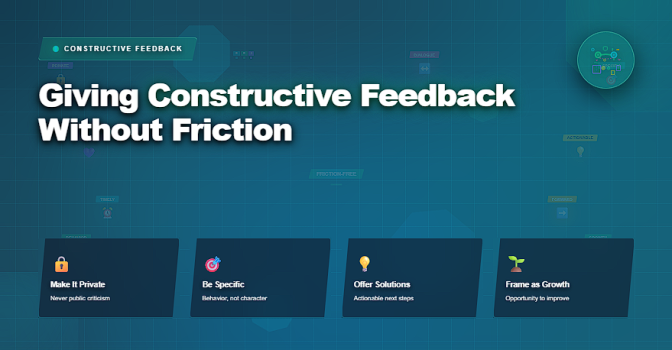
❌ in public
❌ during high stress
❌ long after the behavior occurred
❌ without preparation
Private, calm, and timely feedback is easier to hear and act on.
❌ Common Feedback Mistakes That Increase Friction
❌ mixing feedback with emotion
❌ saving issues for performance reviews
❌ using vague language
❌ talking more than listening
❌ ending feedback without direction
These mistakes make feedback feel like criticism instead of support.
⭐ How Leaders Make Feedback a Normal Process
Strong leaders:
✔️ give feedback frequently, not dramatically
✔️ balance reinforcement and correction
✔️ ask for feedback themselves
✔️ normalize improvement conversations
✔️ follow up on agreed actions
When feedback is routine, friction disappears.
⭐ A Simple Feedback Check for Leaders
Ask yourself:
✔️ Is my feedback about behavior or judgment?
✔️ Does the person know what to do next?
✔️ Would I want to receive this feedback the same way?
If not, refine the message before delivering it.
⭐ Final Thoughts
Constructive feedback should strengthen relationships, not strain them.
When delivered with clarity, respect, and purpose, feedback becomes one of the most powerful tools a leader has to build trust, improve performance, and develop people.
Great leaders do not avoid feedback to keep peace.
They deliver it skillfully so progress can happen without friction.