 MElkhateeb
➡️ Introduction
Agile projects do not fail because teams avoid planning.
They fail when planning is misunderstood.
Top 5 Project Management Software
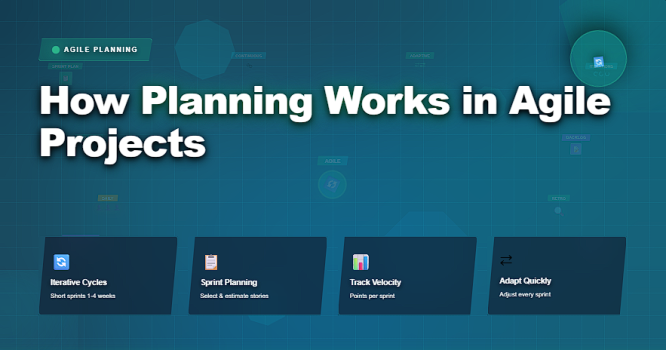
A common myth suggests that Agile means no plan or planning on the fly. In reality, Agile relies on continuous, layered planning—planning that adapts as knowledge increases and uncertainty decreases.
Instead of betting everything on a single upfront plan, Agile spreads planning across the project lifecycle. This allows teams to respond to change without losing direction, predictability, or control.
This article explains how planning really works in Agile projects, how it differs from traditional planning, and how project managers and Agile teams can apply planning discipline without sacrificing flexibility.
✅ What Planning Means in Agile Projects
In Agile, planning is not a one-time event.
It is an ongoing process of alignment and refinement.
Agile planning focuses on:
✔️ defining direction, not fixed scope
✔️ planning at multiple levels
✔️ using short feedback cycles
✔️ adjusting plans based on evidence
✔️ balancing adaptability with commitment
Agile planning answers a different question than traditional planning.
Traditional planning asks:
“What exactly will we deliver, and when?”
Agile planning asks:
“What is the most valuable thing to deliver next, given what we know now?”
✅ How Agile Planning Differs from Traditional Planning
The difference is not a lack of discipline — it is where discipline is applied.
Traditional Planning
✔️ heavy upfront detail
✔️ fixed scope baseline
✔️ changes treated as exceptions
✔️ long-range commitment
Agile Planning
✔️ progressive detail
✔️ flexible scope within constraints
✔️ change treated as learning
✔️ short-range commitment
Agile replaces prediction with controlled discovery.
✅ The Layers of Planning in Agile Projects
Agile planning happens at multiple, connected levels. Each level answers a specific question and has a different planning horizon.
✅ How Planning Works in Agile Projects
Layered planning from vision to sprint execution.
| Planning Level | Focus | Time Horizon |
|---|---|---|
| Vision & Strategy | Product goals, value, success criteria | Months to years |
| Roadmap Planning | Themes, outcomes, priorities | Quarterly / release-based |
| Release Planning | Feature grouping and delivery intent | Weeks to months |
| Sprint Planning | Committed work for the iteration | 1–4 weeks |
| Daily Planning | Task coordination and adjustments | 24 hours |
| Review & Retrospective | Learning and improvement | End of each iteration |
✅ Key Planning Activities in Agile Projects
Agile planning relies on a few core practices:
✔️ backlog refinement to clarify upcoming work
✔️ prioritization based on value and risk
✔️ timeboxing to enforce focus
✔️ estimation using relative sizing
✔️ frequent re-planning based on feedback
Planning becomes lighter as uncertainty increases —
and more detailed as work gets closer.
✅ How Agile Maintains Control Without Fixed Plans
Agile maintains predictability through:
✔️ short planning horizons
✔️ frequent inspection and adaptation
✔️ stable team capacity
✔️ transparent progress metrics
✔️ clear definition of “done”
Control comes from feedback loops, not rigid baselines.
❌ Common Misunderstandings About Agile Planning
❌ “Agile means no planning”
❌ “Plans change, so planning is useless”
❌ “Only the product owner plans”
❌ “Agile planning is informal and optional”
❌ “Deadlines don’t matter in Agile”
Agile planning is structured — just not static.
⭐ Best Practices
✔️ plan often, but lightly
✔️ separate direction from commitment
✔️ refine plans as uncertainty reduces
✔️ protect teams from constant reprioritization
✔️ use planning to enable focus, not pressure
✔️ treat planning as a learning system
⭐ Final Thoughts
Agile planning is not about predicting the future.
It is about being prepared to respond to it.
Strong Agile teams plan continuously, learn rapidly, and adjust deliberately.
They do not abandon planning — they make it adaptive, evidence-based, and human.
Projects succeed in Agile not because plans never change —
but because planning never stops.