 MElkhateeb
➡️ Introduction
Most projects fail at one of two extremes.
Top 5 Project Management Software
Some teams over-plan — spending weeks refining schedules that become outdated the moment execution begins. Others under-plan — jumping into delivery without clarity, then reacting to problems as they appear.
Both approaches create risk.
The real challenge for project managers is not choosing planning or execution.
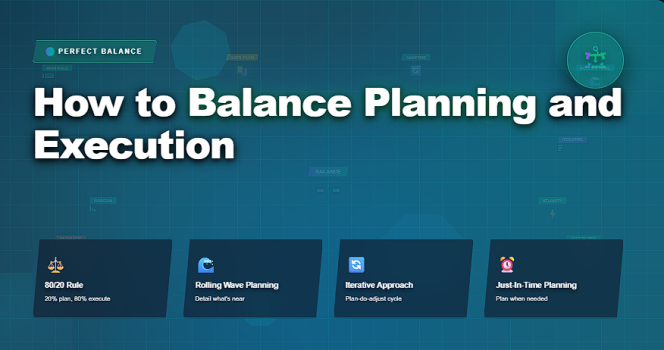
It is learning how to balance planning and execution continuously — so plans guide action, and execution informs better planning.
This article explains why this balance is difficult, how it breaks down, and how project managers can create a healthy, practical rhythm between planning and doing.
✅ Why Planning and Execution Often Fall Out of Balance
Planning and execution usually drift apart because:
✔️ planning is treated as a one-time phase
✔️ execution pressure discourages reflection
✔️ plans are too detailed or too rigid
✔️ teams fear changing approved plans
✔️ progress is measured by activity, not outcomes
When planning stops too early — execution becomes chaotic.
When planning never stops — execution slows to a crawl.
✅ What Balance Really Means in Practice
Balancing planning and execution does not mean equal time spent on both.
It means:
✔️ planning just enough to reduce uncertainty
✔️ executing while monitoring assumptions
✔️ updating plans based on real progress
✔️ protecting momentum without losing control
✔️ making planning a support function — not a barrier
Planning should enable execution, not delay it.
✅ Practices That Balance Planning and Execution
How to keep plans useful while work is moving.
| Practice | How It’s Applied | Why It Works |
|---|---|---|
| Just-Enough Planning | Plan near-term work in more detail | Reduces waste and rigidity |
| Rolling Updates | Refresh plans based on actual progress | Keeps plans realistic |
| Outcome-Based Tracking | Track progress by results, not activity | Aligns execution with goals |
| Decision Checkpoints | Pause briefly to confirm direction | Prevents drift without slowing work |
| Visible Assumptions | Document and review key assumptions | Triggers timely plan adjustments |
✅ How Project Managers Maintain the Balance Day to Day
Effective project managers:
✔️ plan in short, meaningful cycles
✔️ resist over-detailing far-future work
✔️ review plans during execution — not after problems
✔️ treat plan changes as learning, not failure
✔️ keep teams focused on outcomes
They allow execution to inform better planning, continuously.
❌ Common Mistakes That Break the Balance
❌ locking plans too early
❌ refusing to adjust approved schedules
❌ planning to remove all uncertainty
❌ executing without revisiting assumptions
❌ measuring success by “busy-ness”
These mistakes create either paralysis or chaos.
⭐ Benefits of a Healthy Planning–Execution Balance
When planning and execution are balanced:
✔️ teams move faster with confidence
✔️ risks are detected earlier
✔️ rework is reduced
✔️ decisions improve
✔️ stakeholders trust the process
Projects feel controlled — not rigid.
⭐ A Simple Balance Check You Can Use
Project managers can ask weekly:
✔️ Is the plan still helping the team execute?
✔️ Are we learning something new that should change the plan?
✔️ Are we spending the right amount of time planning — not too much, not too little?
If any answer is “no,” balance needs adjustment.
⭐ Final Thoughts
Planning and execution are not competing forces.
They are partners in delivery.
Strong project managers do not choose one over the other.
They balance both intentionally — planning just enough, executing decisively, and adjusting continuously.
That balance is what turns plans into results.