 MElkhateeb
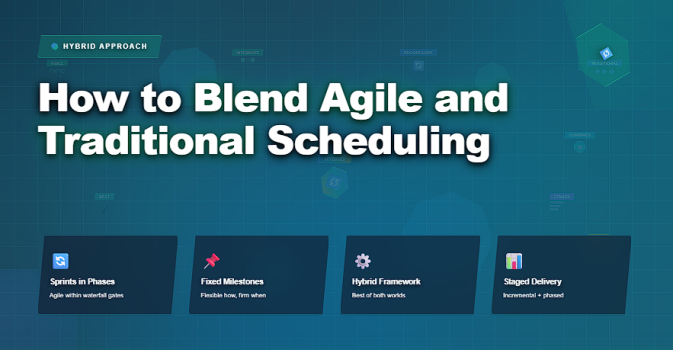
➡️ Introduction
Most projects today do not live entirely in Agile or entirely in traditional project management.
Top 5 Project Management Software
They live in between.
Organizations often need long-term schedules, fixed milestones, and governance requirements — while teams still need flexibility, fast feedback, and adaptive execution. Trying to force one approach usually leads to frustration, unstable plans, or loss of control.
Blending Agile and traditional scheduling is not a compromise.
It is a deliberate hybrid strategy that uses structure where predictability is required and agility where uncertainty is highest.
This article explains how to combine Agile and traditional scheduling in a practical, disciplined way — without creating confusion, double work, or conflicting plans.
✅ Why Pure Agile or Pure Traditional Often Falls Short
Pure traditional scheduling struggles when:
✔️ requirements evolve
✔️ technical uncertainty is high
✔️ learning happens during execution
Pure Agile scheduling struggles when:
✔️ external deadlines are fixed
✔️ contracts require milestone commitments
✔️ multiple teams must coordinate
✔️ governance and reporting are mandatory
Hybrid scheduling exists because real projects face both realities at once.
✅ The Core Principle of Hybrid Scheduling
Hybrid scheduling works when you separate what must be fixed from what can remain flexible.
✔️ Fix outcomes, milestones, and constraints
✔️ Keep scope details and execution flexible
Traditional scheduling answers “When must key outcomes happen?”
Agile planning answers “What is the best way to reach them right now?”
They are complementary, not conflicting.
✅ What to Schedule Traditionally vs Agile
The key is choosing the right level for each approach.
Best suited for Traditional Scheduling
✔️ major milestones
✔️ external commitments
✔️ regulatory deadlines
✔️ phase gates
✔️ dependency-heavy integrations
Best suited for Agile Planning
✔️ feature development
✔️ solution design details
✔️ backlog prioritization
✔️ task execution
✔️ incremental delivery
Hybrid planning connects these layers without forcing one to dominate.
✅ Blending Agile and Traditional Scheduling
Using structure for predictability and agility for execution.
| Planning Layer | Traditional Approach | Agile Approach |
|---|---|---|
| Overall Timeline | High-level milestones and deadlines | Rolling forecasts using velocity |
| Scope Definition | Fixed at milestone level | Flexible backlog prioritization |
| Detailed Planning | Upfront task decomposition | Sprint-level planning only |
| Progress Tracking | Milestone completion | Incremental delivery and flow |
| Change Management | Formal approval process | Backlog reprioritization |
| Risk Management | Risk registers and buffers | Early delivery and feedback |
✅ How to Make Hybrid Scheduling Work in Practice
Successful hybrid scheduling depends on clear boundaries.
Key practices include:
✔️ one integrated master schedule at milestone level
✔️ sprint plans mapped to milestone objectives
✔️ regular alignment between roadmap and sprint outcomes
✔️ visible buffers at milestone level
✔️ transparent communication of confidence levels
The traditional schedule sets direction.
Agile execution determines the path.
✅ Role of the Project Manager in Hybrid Environments
In hybrid projects, the project manager acts as an integrator, not a controller.
Core responsibilities include:
✔️ protecting Agile teams from rigid task-level control
✔️ maintaining milestone visibility for stakeholders
✔️ translating Agile progress into schedule language
✔️ managing dependencies across teams
✔️ ensuring governance requirements are met
✔️ balancing predictability with adaptability
The role shifts from enforcing plans to orchestrating alignment.
❌ Common Hybrid Scheduling Mistakes
❌ running Agile teams with fixed task-level schedules
❌ updating two disconnected plans
❌ forcing velocity to fit deadlines
❌ hiding uncertainty behind detailed Gantt charts
❌ changing scope without adjusting milestones
❌ confusing hybrid with “do everything”
Hybrid works when it is simpler, not heavier.
⭐ Best Practices
✔️ schedule milestones, not tasks
✔️ plan in layers, not all at once
✔️ keep one source of truth
✔️ communicate ranges and confidence levels
✔️ review alignment frequently
✔️ adjust scope before dates whenever possible
⭐ Final Thoughts
Blending Agile and traditional scheduling is not about mixing tools —
it is about mixing mindsets deliberately.
Strong project managers use traditional scheduling to create confidence and alignment, while Agile execution provides adaptability and learning.
Projects succeed in hybrid environments not because plans never change —
but because structure and flexibility work together, not against each other.