
 MElkhateeb
➡️ Introduction
One of the most common reasons projects fail is poor breakdown of work. Tasks are unclear, responsibilities overlap, estimates are inaccurate, and progress becomes difficult to track.
This is exactly where the Work Breakdown Structure (WBS) plays a critical role.
Top 5 Project Management Software
A WBS transforms a complex project into manageable, clearly defined components, making planning, scheduling, cost estimation, and risk management significantly more effective.
In this guide, you’ll learn what a WBS is, why it matters, and how to create one step-by-step, using proven project management best practices.
✅ What Is a Work Breakdown Structure (WBS)?
A Work Breakdown Structure (WBS) is a hierarchical decomposition of the total project scope into smaller, manageable deliverables and work packages.
It answers one key question:
“What work must be done to deliver the project?”
A WBS focuses on deliverables, not activities, ensuring all project scope is captured clearly and completely.
✅ Why a WBS Is Essential in Project Planning
A properly built WBS helps project managers:
✔️ define full project scope clearly
✔️ avoid missing or duplicate work
✔️ improve cost and time estimation
✔️ assign responsibilities accurately
✔️ support schedule and budget baselines
✔️ control scope changes effectively
Without a WBS, planning becomes guesswork.
✅ WBS Principles You Must Follow
Before building a WBS, remember these core rules:
✔️ 100% Rule – the WBS must include all project work
✔️ focus on deliverables, not actions
✔️ each lower level adds more detail
✔️ no overlap between work packages
✔️ work packages must be measurable and assignable
✅ WBS Creation Steps
A practical, repeatable method used by professional project managers.
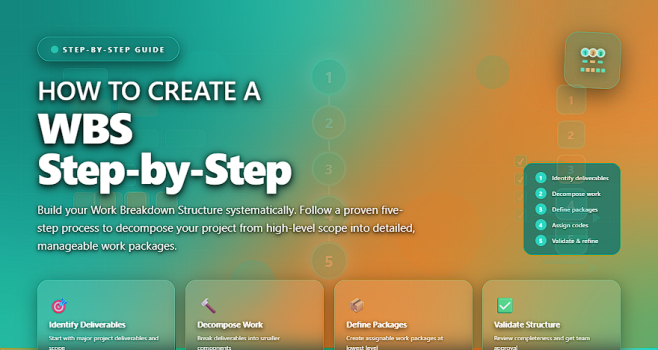
| Step | Action | Outcome |
|---|---|---|
| 1. Define Scope | Review project charter and scope statement | Clear understanding of what is included |
| 2. Identify Deliverables | List major outputs and milestones | Top-level WBS elements |
| 3. Decompose Deliverables | Break deliverables into smaller components | Logical structure of work |
| 4. Define Work Packages | Break down until tasks are manageable | Estimable and assignable work units |
| 5. Validate WBS | Review with stakeholders and team | Confirmed scope completeness |
| 6. Assign Codes | Number WBS elements logically | Traceability and control |
✅ What Is a Work Package?
A work package is the lowest level of the WBS and should:
✔️ have a clear deliverable
✔️ be measurable
✔️ have one owner
✔️ be estimable in time and cost
✔️ fit within reporting periods
If it’s too large to estimate, break it down further.
✅ Common WBS Formats
Project managers may use:
✔️ Deliverable-based WBS (most recommended)
✔️ Phase-based WBS
✔️ Organizational WBS
✔️ Hybrid WBS
Deliverable-based structures offer the best scope control.
❌ Common WBS Mistakes to Avoid
❌ listing activities instead of deliverables
❌ stopping decomposition too early
❌ overlapping work packages
❌ skipping stakeholder validation
❌ creating a WBS after scheduling (wrong order)
✅ How WBS Connects to Other Planning Areas
A strong WBS directly supports:
✔️ project scheduling
✔️ cost estimation
✔️ risk identification
✔️ responsibility assignment (RACI)
✔️ progress tracking
✔️ scope change control
It is the foundation of all planning processes.
⭐ Best Practices
✔️ Involve the team in decomposition
✔️ Keep descriptions clear and simple
✔️ Use consistent naming conventions
✔️ Store WBS in a shared location
✔️ Update only through change control
✅ Final Thoughts
A Work Breakdown Structure is not just a planning artifact —
it is a thinking tool that forces clarity, completeness, and accountability.
If the WBS is weak, the plan will be weak.
If the WBS is strong, the project has a solid foundation.