 MElkhateeb
➡️ Introduction
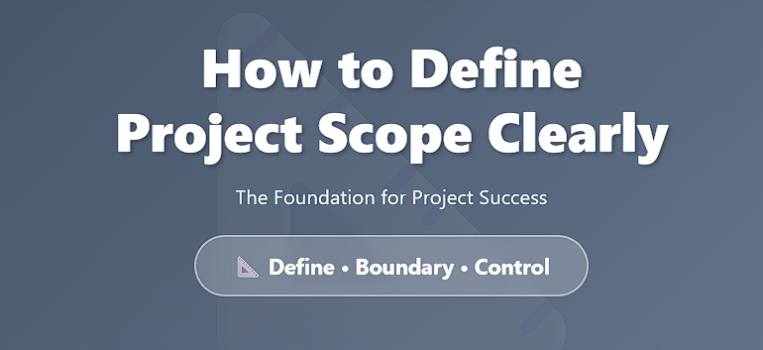
One of the most common reasons projects fail is scope ambiguity — when the team, sponsor, or stakeholders don’t share a clear understanding of what the project will (and won’t) deliver.
Top 5 Project Management Software
Defining your project scope precisely is one of the most critical early steps in project planning. It lays the foundation for schedule, budget, quality, and success measurement.
In this article, you’ll learn how to define project scope clearly, what to include in a scope statement, and how to prevent scope creep that derails timelines and budgets.
✅ What Is Project Scope?
Project scope defines the boundaries of the project — the deliverables, objectives, constraints, and exclusions.
It answers:
✔️ What are we creating or delivering?
✔️ What work is required to deliver it?
✔️ What’s out of scope?
A well-defined scope ensures that everyone is aligned from the start — reducing rework, misunderstandings, and unapproved changes.
✅ Components of a Clear Project Scope
Here’s your responsive .ppx-style table (same design system you’re using) to break down the main components of a precise project scope.
✅ Components of a Clear Project Scope
Key elements that define what’s included — and excluded — in your project.
| Component | Purpose | Example |
|---|---|---|
| Objectives | Defines what success looks like and why the project exists. | Launch an e-commerce website to increase online sales by 30% in six months. |
| Deliverables | Lists tangible outcomes the team must produce. | Website design, backend system, payment gateway integration, and user training manual. |
| Inclusions | Clarifies what is part of the project scope. | Setup of hosting environment and data migration from legacy system. |
| Exclusions | Specifies what will not be delivered to avoid scope creep. | Mobile app development and post-launch customer support. |
| Constraints | Lists limitations such as budget, resources, or timeline. | Budget capped at $150,000 and must go live before Q3. |
| Assumptions | Defines conditions expected to be true for planning accuracy. | All third-party vendors will provide data on time. |
✅ Steps to Define Project Scope Clearly
☑️ 1. Identify Stakeholder Needs
Gather input from all key stakeholders early. Use interviews or workshops to uncover both explicit and hidden expectations.
☑️ 2. Define Deliverables in Detail
Break down what will be delivered in measurable, verifiable terms — avoid vague descriptions like “improve performance.”
☑️ 3. Set Clear Boundaries
Document what’s out of scope to prevent later confusion or unauthorized requests.
☑️ 4. Create a Scope Statement
Summarize objectives, deliverables, boundaries, assumptions, and constraints in a formal document.
☑️ 5. Validate and Approve
Review the scope with sponsors and stakeholders before moving forward. Approval marks the “scope baseline” for future changes.
☑️ 6. Manage Scope Creep
Implement a change control process to review and approve modifications before they impact time or cost.
✅ Best Practices
✔️ Use visuals like Work Breakdown Structures (WBS) to represent scope hierarchy.
✔️ Keep your scope statement short but specific — avoid jargon.
✔️ Review and update the scope as part of every major phase review.
✔️ Store scope documents in your project management system for easy access.
✅ Common Mistakes to Avoid
❌ Failing to involve key stakeholders in the definition phase.
❌ Leaving deliverables or exclusions unclear.
❌ Skipping validation — assuming everyone “gets it.”
❌ Accepting change requests informally.
✅ Final Thoughts
Defining your project scope clearly is more than a planning step — it’s the foundation for project success.
A precise scope ensures alignment, controls expectations, and protects your project from scope creep.
A well-defined scope isn’t just documentation — it’s your blueprint for delivery and control.