 MElkhateeb
➡️ Introduction
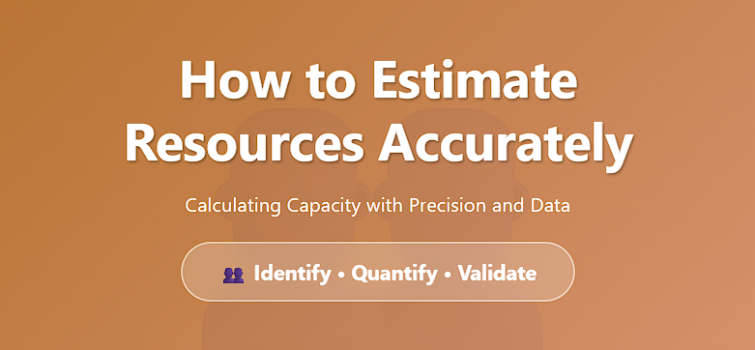
Resource estimation lies at the heart of project success. Even the best schedules and budgets will fail if the resources — people, equipment, and materials — are misjudged.
Top 5 Project Management Software
Accurate resource estimation helps project managers:
✔️ Plan realistic timelines.
✔️ Allocate costs effectively.
✔️ Prevent burnout or underutilization.
✔️ Build stakeholder confidence.
This guide explains how to estimate resources with precision using structured methods, data-driven insights, and practical tools.
✅ What Is Resource Estimation?
Resource estimation is the process of determining the type, quantity, and timing of resources needed to complete each project activity.
It involves identifying what skills, tools, or materials are required, how long they’ll be needed, and at what cost.
Accurate estimation ensures that you have the right resources, at the right time, in the right quantity — a critical balance for both productivity and profitability.
✅ Key Types of Resources
Before estimating, you must first identify all resource categories involved in your project:
✔️ Human Resources – team members, contractors, consultants.
✔️ Equipment – tools, machines, or software licenses.
✔️ Materials – consumables, components, or supplies.
✔️ Facilities – office space, labs, or sites required temporarily.
✔️ Financial Resources – funding or credit available for procurement.
✅ Steps to Estimate Resources Accurately
Practical phases for forecasting resources with precision and accountability.
| Step | Description | Best Practice |
|---|---|---|
| 1. Define Scope and Deliverables | Clarify project objectives and expected outcomes to identify all required tasks. | Use a Work Breakdown Structure (WBS) to capture every component of work. |
| 2. Identify Required Resources | List all skills, roles, tools, and materials necessary for each task. | Engage functional managers or SMEs to verify role requirements. |
| 3. Estimate Resource Quantities | Determine how many units or people are needed per task and for how long. | Use parametric estimating (e.g., work hours per deliverable unit). |
| 4. Assess Availability and Constraints | Check schedules, holidays, and workload capacity of resources. | Apply resource calendars in your PM software for realistic timelines. |
| 5. Validate with Historical Data | Compare your estimates with past projects of similar scope or complexity. | Leverage organizational lessons learned and benchmarks. |
| 6. Review and Adjust with Stakeholders | Collaborate with team leads and finance to finalize estimates. | Conduct resource estimation workshops before baseline approval. |
✅ Methods for Resource Estimation
✔️ Analogous Estimating – Uses data from previous similar projects.
✔️ Parametric Estimating – Applies mathematical models (e.g., design hours per deliverable).
✔️ Bottom-Up Estimating – Builds estimates at the task level for high accuracy.
✔️ Expert Judgment – Leverages experience of technical or functional experts.
✔️ Three-Point Estimating – Uses optimistic, pessimistic, and most likely values to reduce bias.
✅ Tools for Resource Estimation and Tracking
✔️ Microsoft Project – Resource allocation, workload charts, and baselines.
✔️ Monday.com – Visual boards for workload and team capacity management.
✔️ Smartsheet – Resource calendars and real-time dashboards.
✔️ Miro – For collaborative planning and effort estimation workshops.
✔️ Excel/Google Sheets – Simple and customizable resource estimation templates.
✅ Common Mistakes to Avoid
❌ Ignoring resource availability during estimation.
❌ Over-relying on expert judgment without data validation.
❌ Forgetting indirect or shared resources (e.g., IT support).
❌ Failing to update estimates after scope or schedule changes.
❌ Neglecting productivity factors such as learning curves and fatigue.
✅ Best Practices
✔️ Use a combination of quantitative methods and expert validation.
✔️ Maintain a resource database for historical reference.
✔️ Involve team members early to gain buy-in and realism.
✔️ Factor in risk reserves for high-uncertainty tasks.
✔️ Re-evaluate estimates at every phase gate or milestone.
✅ Final Thoughts
Accurate resource estimation is the cornerstone of a feasible project plan.
It turns assumptions into actionable numbers, ensures balance between scope and capacity, and safeguards delivery within budget and timeline.
Great project managers don’t guess resources — they calculate them.