 MElkhateeb
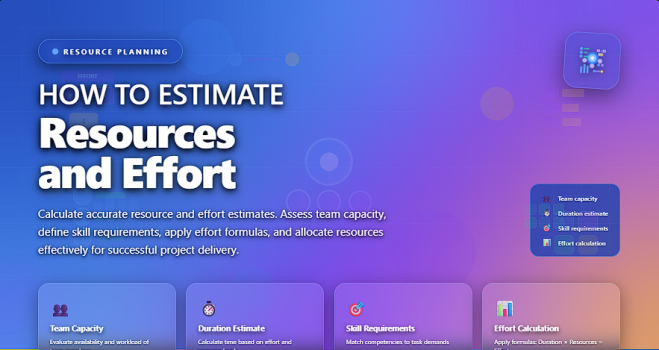
Below is your professional, educational, SEO-optimized blog article on How to Estimate Resources and Effort — written in an expert PM tone and ready to perform on Google, ChatGPT, Claude, Perplexity, and all AI search engines.
Top 5 Project Management Software
✔️ If the article contains a table, it is built using your premium responsive .ppx code, fully optimized for mobile, tablet, and desktop.
✔️ Tone: Deep, educational, expert-level.
✔️ SEO optimized with clear structure, scannability, and semantic richness.
✅ How to Estimate Resources and Effort
A Complete Guide for Project Managers
➡️ Introduction
Successful project delivery depends heavily on how accurately you estimate resources (people, tools, materials) and effort (workload and time required to complete tasks). Poor estimation leads to missed deadlines, cost overruns, and team burnout — while accurate estimates strengthen planning, forecasting, and stakeholder confidence.
This article explains what resource and effort estimation really means, how to perform it step-by-step, and includes a responsive comparison table of the most effective estimation techniques used by modern project managers.
✅ What Does “Estimating Resources and Effort” Mean?
Resource and effort estimation is the process of determining:
- What resources are needed (human, material, technological)
- How much effort each task requires (usually measured in hours or days)
- Who is best suited to complete the work
- How long the entire project will take, accounting for availability and constraints
Accurate estimation enables better scheduling, budgeting, staffing, and risk management.
✅ Key Techniques for Resource and Effort Estimation
Below is a responsive table using your .ppx code, comparing the most commonly used estimation methods.
<!-- Resource & Effort Estimation Techniques – Responsive Table -->
<section class="ppx-wrap" aria-labelledby="ppx-estimation-heading">
  <style>
    .ppx-wrap{
      --ppx-bg:#fff;--ppx-fg:#0f172a;--ppx-muted:#475569;
      --ppx-line:#e2e8f0;--ppx-soft:#eef5ff;
      --ppx-radius:16px;--ppx-shadow:0 8px 24px rgba(15,23,42,.08);
      --ppx-px:clamp(14px,2vw,22px);--ppx-py:clamp(12px,2vw,18px);
      background:#fff;border:1px solid var(--ppx-line);
      border-radius:var(--ppx-radius);box-shadow:var(--ppx-shadow);
      overflow:hidden;color:var(--ppx-fg)
    }
    .ppx-header{
      padding:var(--ppx-py) var(--ppx-px);
      background:linear-gradient(0deg,#fff,var(--ppx-soft));
      border-bottom:1px solid var(--ppx-line)
    }
    .ppx-title{margin:0 0 6px;font-size:clamp(18px,2.2vw,24px)}
    .ppx-sub{margin:0;color:var(--ppx-muted);font-size:clamp(13px,1.8vw,15px)}
    .ppx-scroll{overflow-x:auto;-webkit-overflow-scrolling:touch}
    .ppx-table{width:100%;border-collapse:separate;border-spacing:0}
    .ppx-table thead th{
      background:#f8fafc;color:var(--ppx-muted);
      font-weight:700;padding:14px var(--ppx-px);
      border-bottom:1px solid var(--ppx-line);white-space:nowrap;text-align:left}
    .ppx-table tbody td{
      padding:14px var(--ppx-px);border-bottom:1px solid var(--ppx-line)}
    .ppx-cell--label{font-weight:700;width:30%}
    .ppx-table tbody tr:hover{background:#fbfdff}
    @media(max-width:720px){
      .ppx-table thead{display:none}
      .ppx-table,.ppx-table tbody,.ppx-table tr,.ppx-table td{
        display:block;width:100%}
      .ppx-table tbody tr{
        margin:12px var(--ppx-px);padding:12px;border:1px solid var(--ppx-line);
        background:#fff;border-radius:14px;box-shadow:var(--ppx-shadow)}
      .ppx-table tbody td{border:0;padding:6px 0}
      .ppx-table tbody td.ppx-cell--label{padding-bottom:8px;font-size:16px}
      .ppx-table tbody td[data-label]{
        display:grid;grid-template-columns:130px 1fr;gap:8px}
      .ppx-table tbody td[data-label]::before{
        content:attr(data-label);color:var(--ppx-muted);font-weight:600}
    }
  </style>

  <header class="ppx-header">
    <h2 id="ppx-estimation-heading" class="ppx-title">✅ Resource & Effort Estimation Techniques</h2>
    <p class="ppx-sub">A comparison of the most widely used methods in project management.</p>
  </header>

  <div class="ppx-scroll" tabindex="0">
    <table class="ppx-table">
      <thead>
        <tr>
          <th>Technique</th>
          <th>How It Works</th>
          <th>Best Used When</th>
        </tr>
      </thead>
      <tbody>
        <tr>
          <td class="ppx-cell--label">Expert Judgment</td>
          <td data-label="How It Works">Consult experts with prior experience.</td>
          <td data-label="Best Used When">Past projects are similar and SMEs are available.</td>
        </tr>
        <tr>
          <td class="ppx-cell--label">Analogous Estimating</td>
          <td data-label="How It Works">Use historical data from similar tasks.</td>
          <td data-label="Best Used When">Early in planning with limited information.</td>
        </tr>
        <tr>
          <td class="ppx-cell--label">Parametric Estimating</td>
          <td data-label="How It Works">Use unit rates (e.g., hours per feature).</td>
          <td data-label="Best Used When">Work is predictable and quantifiable.</td>
        </tr>
        <tr>
          <td class="ppx-cell--label">Three-Point Estimating (PERT)</td>
          <td data-label="How It Works">Use optimistic, pessimistic, and most likely values.</td>
          <td data-label="Best Used When">There is uncertainty or variability in tasks.</td>
        </tr>
        <tr>
          <td class="ppx-cell--label">Bottom-Up Estimating</td>
          <td data-label="How It Works">Estimate each task individually and sum them.</td>
          <td data-label="Best Used When">You need high accuracy and have detailed WBS.</td>
        </tr>
        <tr>
          <td class="ppx-cell--label">Resource Breakdown Structure (RBS)</td>
          <td data-label="How It Works">Categorize resources and estimate per category.</td>
          <td data-label="Best Used When">Large teams or multi-discipline projects.</td>
        </tr>
      </tbody>
    </table>
  </div>
</section>
✅ Step-by-Step: How to Estimate Resources and Effort
✔️ 1. Start With a Detailed Work Breakdown Structure (WBS)
Effort estimation cannot begin without task clarity.
A WBS breaks the project into smaller, manageable work packages.
Each work package can then be estimated more accurately.
✔️ 2. Identify All Required Resource Types
Consider resources such as:
✔️ human (team roles, skills, availability)
✔️ equipment (machines, devices, tools)
✔️ materials (physical supplies)
✔️ software and digital tools
✔️ external vendors
A resource plan ensures nothing is overlooked.
✔️ 3. Determine Resource Availability
Real-world constraints matter:
- team schedules
- holidays
- competing projects
- part-time vs full-time allocation
- vendor lead times
Availability affects both effort and duration.
✔️ 4. Estimate Effort for Each Task
Using techniques from the table above, estimate:
- labor hours
- machine hours
- setup time
- review time
- testing and validation time
Document assumptions behind each estimate.
✔️ 5. Convert Effort Into Duration
Effort ≠ Duration
Duration is impacted by:
- number of people assigned
- resource productivity
- task dependencies
- parallel vs sequential work
Formula:
Duration = Effort / (Number of Resources × Productivity Rate)
✔️ 6. Validate Estimates With the Team
Hold a review session with:
✔️ functional leads
✔️ senior engineers
✔️ finance/PMO when applicable
✔️ vendors
This improves accuracy and gains buy-in.
✔️ 7. Add Contingency and Buffers
No estimate is perfect.
Add:
✔️ contingency reserves for known risks
✔️ management reserves for unknown risks
This prevents “surprise delays.”
✔️ 8. Document All Assumptions
Assumptions affect accuracy. Examples:
- “Developer productivity = 6 hours/day.”
- “Vendor will deliver materials in 5 days.”
Clear documentation avoids future disputes.
✔️ 9. Continuously Refine the Estimates
As the project evolves, update estimates based on:
✔️ actual performance
✔️ new risks
✔️ scope changes
✔️ team capacity shifts
Estimation is a living process, not a one-time event.
❌ Common Estimation Mistakes
Avoid the following mistakes:
❌ confusing effort with duration
❌ assigning unrealistic workloads
❌ ignoring resource availability
❌ underestimating review and approval time
❌ relying on a single estimation technique
❌ forgetting about overhead and coordination time
⭐ Best Practices for Accurate Estimation
✔️ combine multiple estimation techniques
✔️ involve the people who will perform the work
✔️ use historical data whenever possible
✔️ break work into small, clear tasks
✔️ apply buffers for uncertain or new work
✔️ track actuals for future improvement
⭐ Final Thoughts
Estimating resources and effort is both an analytical and collaborative exercise.
With the right tools, techniques, and team involvement, project managers can produce highly accurate estimates that support reliable scheduling, budgeting, staffing, and overall delivery success.
Great project managers don’t guess — they estimate with evidence, refine continuously, and plan with discipline.
🔍 SEO Optimization Summary
Primary Keyword: how to estimate resources and effort
Secondary Keywords: effort estimation techniques, resource planning, project estimation methods
Meta Title: How to Estimate Resources and Effort: A Complete Guide for Project Managers
Meta Description: Learn how to estimate project resources and effort using expert techniques, WBS, parametric estimating, PERT, and real-world best practices.
Image Alt Text: Project manager analyzing resource and effort estimates on a digital dashboard.
If you want the next article in your Planning Series, I can write:
➡️ Effort vs Duration: Why They Are Not the Same
➡️ Building a Resource Management Plan
➡️ How to Forecast Team Capacity Accurately
Just tell me!