 MElkhateeb
➡️ Introduction
Many professionals ask, “What leadership style should I use?”
The better question is: “What leadership style fits me — and when should I adapt it?”
Top 5 Project Management Software
Leadership style is not something you copy from a book or adopt permanently after a training course. It develops from how you think, decide, communicate, and react under pressure.
Great leaders do not imitate others.
They understand themselves — and adjust intentionally based on context.
This article explains how to identify your personal leadership style, how to validate it in real project environments, and how to refine it over time without losing authenticity.
✅ What “Personal Leadership Style” Really Means
Your personal leadership style is the consistent pattern of behaviors you demonstrate when leading others.
It includes:
✔️ how you make decisions
✔️ how you communicate expectations
✔️ how you respond to conflict
✔️ how you motivate people
✔️ how you handle uncertainty
It is not about labels — it is about observable behavior.
✅ Why Finding Your Leadership Style Matters
Understanding your leadership style helps you:
✔️ lead with confidence
✔️ avoid overcorrecting under pressure
✔️ recognize blind spots early
✔️ adapt without losing credibility
✔️ build trust through consistency
Leaders who lack self-awareness often appear unpredictable — even when their intentions are good.
➡️ Step 1: Observe How You Lead Under Pressure
Your true leadership style appears when conditions are difficult, not when everything is calm.
Ask yourself:
✔️ Do I take control or seek input first?
✔️ Do I prioritize speed or consensus?
✔️ Do I focus on people or outcomes?
✔️ Do I become more directive or more supportive?
Patterns here are more revealing than preferences.
✅ Common Leadership Tendencies
Identifying patterns in how you naturally lead.
| Tendency | Typical Behavior | What It May Indicate |
|---|---|---|
| Decision-Driven | Acts quickly and provides direction | Directive or decisive leadership style |
| People-Focused | Checks morale and engagement frequently | Coaching or supportive leadership style |
| Collaborative | Seeks input before major decisions | Participative leadership style |
| Autonomy-Oriented | Delegates and trusts execution | Delegative leadership style |
| Vision-Oriented | Connects work to purpose and future goals | Transformational leadership style |
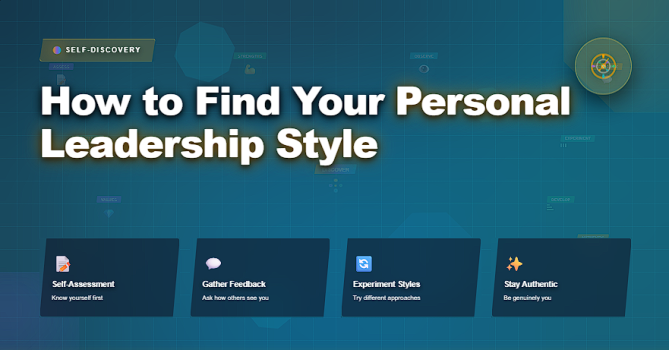
✅ Step 3: Gather Feedback from Others
Self-perception is incomplete without feedback.
Ask trusted colleagues:
✔️ How do you experience my leadership?
✔️ When am I most effective?
✔️ When do I create friction or confusion?
✔️ What should I do more — or less — often?
Patterns in feedback reveal your real impact.
✅ Step 4: Test and Refine Your Style
Your leadership style is not fixed.
Refine it by:
✔️ experimenting with different approaches
✔️ observing team response
✔️ adjusting communication methods
✔️ reflecting after key decisions
✔️ learning from outcomes — not intentions
Growth comes from intentional adaptation.
❌ Common Mistakes When Finding a Leadership Style
❌ trying to copy admired leaders
❌ forcing a style that feels unnatural
❌ assuming one style fits all situations
❌ ignoring feedback
❌ confusing authority with leadership
Authenticity matters more than labels.
⭐ How Strong Leaders Balance Authenticity and Flexibility
Great leaders:
✔️ remain true to their values
✔️ adapt behavior without losing identity
✔️ understand when to stretch beyond comfort
✔️ know their default tendencies
✔️ choose consciously rather than reactively
Leadership maturity is the ability to stay grounded while adapting.
⭐ Final Thoughts
Finding your personal leadership style is not about categorization.
It is about self-awareness, consistency, and growth.
The most effective leaders know who they are, how they lead, and when to adapt — without pretending to be someone else.
Leadership starts with understanding yourself.