 MElkhateeb
➡️ Introduction
No matter how experienced your team is, or how strong your project plan may be, unfinished deliverables are one of the most common—and most disruptive—issues in project management. They can delay milestones, affect quality, increase costs, and weaken stakeholder confidence.
Top 5 Project Management Software
However, not all unfinished deliverables reflect poor performance. Sometimes the cause is external constraints, unexpected risks, unclear requirements, or shifting priorities.
The key for project managers is not to avoid unfinished deliverables (because they will inevitably occur) but to know how to manage, resolve, and prevent them using a structured approach.
This article explains how to professionally handle unfinished deliverables, maintain control, and protect the integrity of your project.
✅ What Are Unfinished Deliverables?
Unfinished deliverables are project outputs—documents, features, components, tasks, or services—that were not completed by the planned deadline or do not meet the required quality standards.
They typically fall under three categories:
✔️ Incomplete work — the deliverable is only partially finished
✔️ Incorrect work — the output is finished but poor quality
✔️ Unvalidated work — not yet reviewed, tested, or approved
The root cause determines how you should respond.
✅ Why Unfinished Deliverables Matter
Leaving unfinished deliverables unresolved can create:
✔️ schedule delays
✔️ additional rework and hidden costs
✔️ resource conflicts
✔️ stakeholder dissatisfaction
✔️ cascading delays across dependent tasks
✔️ reduced project credibility
Effective handling protects the project’s performance and reputation.
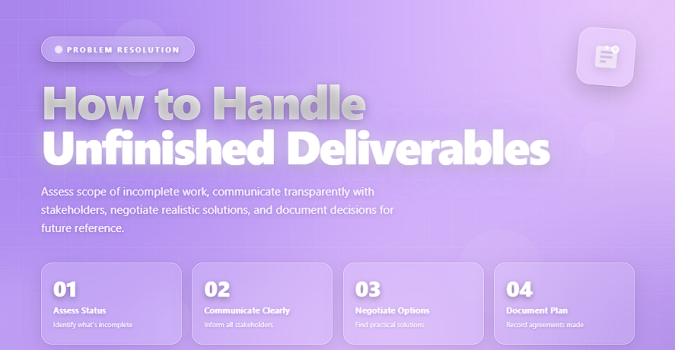
✅ How to Handle Unfinished Deliverables (Step-by-Step)
✔️ 1. Assess the Root Cause Immediately
Before taking any action, understand why the deliverable is unfinished.
Common root causes include:
- unrealistic timelines
- unclear requirements
- skill or resource shortages
- dependencies on other teams
- technical difficulties
- scope changes
- unexpected risks
A root-cause analysis (RCA) or quick team discussion can clarify where the issue began.
✔️ 2. Re-evaluate the Deliverable’s Priority
Not every unfinished deliverable requires the same urgency. Consider:
✔️ Is it on the critical path?
✔️ Does it affect other dependent tasks?
✔️ Does the client need it immediately?
✔️ Is there a regulatory or compliance deadline?
Understanding priority dictates whether you escalate, fast-track, or reschedule.
✔️ 3. Communicate Early with Stakeholders
Silence is dangerous. Communicate:
- what is unfinished
- why it happened
- the impact
- the options for resolution
- the revised plan
Executives and clients respond far better to early transparency than last-minute surprises.
✔️ 4. Decide on the Best Recovery Strategy
Depending on the situation, choose one of the following:
➡️ Option A: Extend the Deadline
If the deliverable is essential and cannot be rushed.
➡️ Option B: Re-assign Resources**
Shift work to someone with more bandwidth or expertise.
➡️ Option C: Reduce Scope Temporarily
Provide a partial version now and expand later.
➡️ Option D: Fast-Track or Crash the Task
Add resources or overlap activities.
➡️ Option E: Replace the Deliverable
Sometimes an alternative output solves the same need.
➡️ Option F: Escalate to Sponsors
For high-impact deliverables on the critical path.
✔️ 5. Update the Project Schedule and Baseline
If the unfinished deliverable impacts time or cost, update:
✔️ schedule
✔️ work breakdown structure (WBS)
✔️ resource plan
✔️ budget baseline (if needed)
✔️ dependencies and milestones
This ensures the entire project plan stays realistic and aligned.
✔️ 6. Strengthen Quality Checks to Prevent Rework
Most unfinished deliverables occur because of weak quality control.
Apply:
✔️ peer reviews
✔️ checklists
✔️ early testing and validation
✔️ stage approvals
✔️ clearer acceptance criteria
This reduces rework and ensures smoother completion in the future.
✔️ 7. Document the Issue for Lessons Learned
Record what happened, why it occurred, and how it was resolved.
This helps you:
✔️ identify patterns
✔️ refine planning methods
✔️ prevent similar delays in future projects
Unfinished deliverables are valuable learning moments when documented properly.
✔️ 8. Close the Deliverable with Formal Acceptance
Once the deliverable is completed and validated:
✔️ confirm it meets quality standards
✔️ obtain client or stakeholder approval
✔️ record its final status
✔️ update the deliverables log
This ensures traceability and supports smooth project closure.
❌ Common Mistakes to Avoid
Avoid these pitfalls that make unfinished deliverables worse:
❌ Ignoring the problem until the deadline
❌ Blaming individuals instead of finding root causes
❌ Changing the schedule without formal approval
❌ Delivering low-quality work just to “finish”
❌ Hiding delays from stakeholders
❌ Not updating the risk and issue logs
Professional handling requires visibility, not avoidance.
⭐ Best Practices
✔️ Use frequent check-ins to detect delays early
✔️ Confirm requirements clearly from day one
✔️ Use work-in-progress limits to avoid overload
✔️ Keep a robust quality assurance process
✔️ Use dashboards for real-time progress tracking
✔️ Assign deliverable owners with clear accountability
⭐ Final Thoughts
Unfinished deliverables do not define the failure of a project —
poor management of unfinished deliverables does.
With a structured approach, transparent communication, and strong preventive practices, project managers can turn delays into opportunities for improvement and keep the project under control.
Great project managers don’t just complete deliverables.
They manage them professionally from start to finish.