 MElkhateeb
➡️ Introduction
Plans only create value when they connect to real time.
Top 5 Project Management Software
Many projects fail not because planning tools are weak, but because plans live in one system while time lives in another. Tasks sit in project tools. Meetings live in calendars. Deadlines are tracked somewhere else. The result is confusion, missed commitments, and constant rescheduling.
Integrating planning tools with calendars closes this gap.
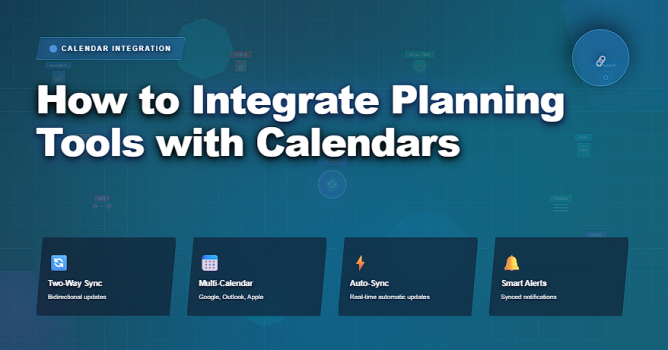
When project plans are connected directly to calendars like Google Calendar and Microsoft Outlook, teams gain visibility into when work actually happens, not just when it is planned.
This article explains why calendar integration matters, how it works in practice, and how project managers can implement it effectively without overcomplicating their systems.
✅ What Does Calendar Integration Mean in Project Planning?
Calendar integration means synchronizing planned work with time-based commitments so that:
✔️ tasks appear alongside meetings
✔️ deadlines are visible in daily schedules
✔️ workload is aligned with availability
✔️ conflicts are detected early
✔️ plans reflect reality
Instead of treating calendars and planning tools as separate worlds, integration turns them into one coordinated system.
✅ Why Integrating Planning Tools with Calendars Matters
Without integration, teams often experience:
❌ tasks scheduled on days already full of meetings
❌ unrealistic deadlines
❌ hidden overload
❌ last-minute rescheduling
❌ poor time awareness
With proper integration, teams gain:
✔️ realistic scheduling
✔️ better time protection
✔️ fewer conflicts
✔️ improved accountability
✔️ clearer expectations
This is especially important in hybrid and remote environments.
📌 Common Planning Tools That Support Calendar Integration
Most modern planning tools support calendar connections, including:
✔️ project management tools (task timelines, Gantt charts)
✔️ spreadsheet-based plans (Excel, Google Sheets)
✔️ work management platforms
✔️ personal task managers
Calendars act as the execution layer for all of them.
📌 What Should Be Integrated (and What Should Not)
Not everything belongs on a calendar.
Best Items to Sync
✔️ milestones
✔️ key deadlines
✔️ time-bound tasks
✔️ critical handovers
✔️ reviews and approvals
Items That Usually Should Not Sync
❌ low-priority tasks
❌ long task lists
❌ background backlog items
❌ optional work
The goal is signal, not noise.
✅ Integrating Planning Tools with Calendars
A practical workflow for connecting plans to real time.
| Step | Action | Purpose |
|---|---|---|
| Identify Key Items | Select milestones and time-critical tasks | Prevents calendar overload |
| Enable Calendar Sync | Connect planning tool to calendar platform | Creates real-time visibility |
| Define Sync Rules | Choose what updates automatically | Keeps schedules accurate |
| Review Conflicts | Check overlaps with meetings | Avoids hidden overload |
| Adjust Plans | Reschedule tasks based on availability | Aligns plans with reality |
| Maintain Weekly | Review sync health regularly | Prevents drift over time |
❌ Common Mistakes in Calendar Integration
❌ syncing every task automatically
❌ treating calendars as task managers
❌ ignoring meeting load
❌ failing to define update ownership
❌ allowing duplicate events
❌ not reviewing sync accuracy
These mistakes create noise instead of clarity.
⭐ Best Practices for Project Managers
✔️ sync only what affects time
✔️ protect focus time intentionally
✔️ review calendars during planning
✔️ treat meetings as capacity consumers
✔️ keep one system as the source of truth
✔️ align team norms around calendar usage
⭐ Final Thoughts
Integrating planning tools with calendars is not about control —
it is about alignment.
When plans reflect actual time commitments:
✔️ schedules become realistic
✔️ overload becomes visible
✔️ priorities are respected
✔️ delivery becomes predictable
Great project managers don’t separate planning from time.
They connect them — and calendars are the bridge that makes planning real.