 MElkhateeb
➡️ Introduction
Setbacks are inevitable.
Loss of motivation is optional — if handled correctly.
Top 5 Project Management Software
Projects fail milestones, plans change, clients push back, and unexpected risks materialize. What determines long-term success is not avoiding setbacks, but how leaders help teams recover from them.
When setbacks are ignored or mishandled, motivation collapses quietly. People disengage, effort becomes mechanical, and confidence erodes. When setbacks are addressed constructively, teams often emerge more focused, resilient, and aligned than before.
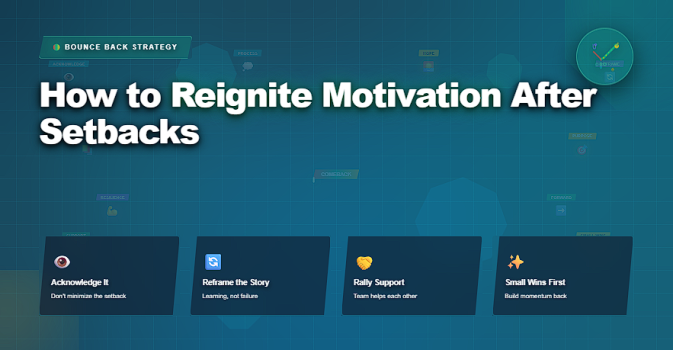
This article explains why motivation drops after setbacks, what leaders often get wrong, and how to reignite motivation in a way that restores momentum and trust.
✅ Why Setbacks Damage Motivation
Setbacks hurt motivation when they create:
✔️ loss of confidence
✔️ uncertainty about direction
✔️ fear of blame
✔️ effort that feels wasted
✔️ emotional fatigue
People do not lose motivation because of failure itself —
they lose it because the meaning of effort becomes unclear.
✅ What Reigniting Motivation Really Requires
After a setback, teams need:
✔️ clarity, not pressure
✔️ acknowledgment, not denial
✔️ direction, not urgency
✔️ safety, not blame
✔️ progress, not promises
Motivation returns when people believe their effort still matters.
✅ Reigniting Motivation After Setbacks
Leadership actions that restore confidence and momentum.
| Leadership Action | How It Helps | Why It Works |
|---|---|---|
| Acknowledge the Setback Openly | Validates team experience | Restores trust and honesty |
| Separate Learning from Blame | Reduces fear and defensiveness | Encourages ownership and recovery |
| Reframe the Purpose | Reconnects effort to meaning | Motivation returns when work matters |
| Reset Short-Term Goals | Creates achievable progress | Momentum rebuilds confidence |
| Highlight What Still Works | Balances perspective | Prevents total loss of morale |
✅ The Leader’s Role Immediately After a Setback
The first response sets the tone.
Effective leaders:
✔️ stay calm and visible
✔️ communicate facts clearly
✔️ avoid emotional reactions
✔️ protect the team from external blame
✔️ focus on recovery, not punishment
Silence or panic amplifies damage.
❌ Common Mistakes That Kill Motivation After Setbacks
❌ pretending nothing happened
❌ assigning blame too quickly
❌ increasing pressure to “make up time”
❌ focusing only on what went wrong
❌ delaying communication
These actions turn a setback into a long-term morale problem.
⭐ How Teams Regain Confidence
Confidence returns when:
✔️ small wins are visible
✔️ effort is acknowledged
✔️ lessons are applied quickly
✔️ direction feels stable again
✔️ leadership is consistent
Recovery is built through action, not reassurance.
⭐ A Simple Recovery Check for Leaders
Ask yourself:
✔️ Does the team understand what happened?
✔️ Do they see a clear path forward?
✔️ Is progress being measured in short cycles?
If any answer is unclear, motivation remains fragile.
⭐ Final Thoughts
Setbacks do not define a team.
The recovery does.
Teams lose motivation when failure feels final or meaningless. They regain it when leaders restore clarity, purpose, and progress.
Great leaders do not demand motivation after setbacks.
They rebuild the conditions that allow motivation to return naturally.