 MElkhateeb
➡️ Introduction
Most team problems are not caused by lack of skill or motivation.
They are caused by unclear norms and unspoken expectations.
Top 5 Project Management Software
When teams do not share a common understanding of how to work together, confusion fills the gap. People make assumptions. Frustration grows. Small issues turn into repeated conflict.
High-performing teams are not built on rules alone — they are built on clear, agreed, and consistently reinforced norms.
This article explains what team norms and expectations really are, why they matter, and how leaders can set them in a practical, sustainable way that improves performance and trust.
✅ What Team Norms and Expectations Really Mean
Team norms define how the team works together.
Team expectations define what the team commits to.
Together, they answer questions such as:
✔️ How do we communicate?
✔️ How do we make decisions?
✔️ How do we handle conflict?
✔️ What does “on time” really mean?
✔️ What behaviors are acceptable — and not?
When norms are unclear, teams rely on personal habits.
When norms are clear, teams rely on shared standards.
✅ Why Clear Norms Are Critical for Team Performance
Clear team norms:
✔️ reduce misunderstandings
✔️ prevent repeated friction
✔️ improve accountability
✔️ increase psychological safety
✔️ speed up decision-making
Without norms, leaders spend time resolving the same issues again and again.
✅ Essential Team Norms and Expectations
The foundations of effective collaboration.
| Team Norm | What It Defines | Why It Matters |
|---|---|---|
| Communication Norms | How and when the team communicates | Prevents misunderstandings and delays |
| Decision-Making | Who decides and how decisions are made | Avoids confusion and rework |
| Accountability | Ownership of tasks and commitments | Builds trust and reliability |
| Meeting Behavior | Preparation, participation, and follow-up | Protects time and focus |
| Conflict Handling | How disagreements are addressed | Prevents tension from escalating |
✅ How to Set Team Norms Step by Step
Step 1: Make Expectations Explicit
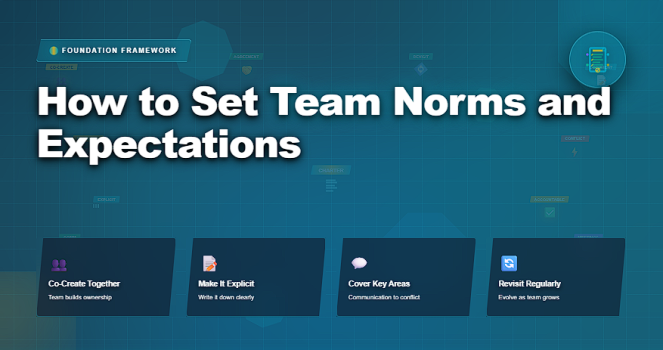
Do not assume alignment. Discuss norms openly and document them.
Step 2: Involve the Team
Norms imposed without discussion are rarely respected. Shared ownership increases commitment.
Step 3: Keep Norms Practical
Focus on behaviors that directly affect daily work — not abstract values.
Step 4: Reinforce Through Action
Leaders must model the norms consistently. Behavior sets the standard.
Step 5: Review and Adjust
Norms should evolve as the team grows or conditions change.
❌ Common Mistakes When Setting Team Norms
❌ assuming everyone already agrees
❌ creating too many rules
❌ documenting norms but never using them
❌ tolerating violations silently
❌ enforcing norms selectively
Norms only work when they are lived, not just written.
⭐ How Leaders Sustain Team Norms Over Time
Effective leaders:
✔️ revisit norms during retrospectives
✔️ address violations early and calmly
✔️ praise behaviors that reinforce norms
✔️ adjust expectations after major changes
✔️ treat norms as performance enablers, not restrictions
Consistency is more important than perfection.
⭐ Final Thoughts
Team norms and expectations are not bureaucracy.
They are clarity in action.
When teams know what is expected — and see leaders honoring those expectations — collaboration improves, conflict decreases, and performance becomes sustainable.
Strong teams do not rely on assumptions.
They rely on shared understanding and consistent behavior.