 MElkhateeb
➡️ Introduction
Interdependent tasks are unavoidable in real projects.
What is avoidable is unnecessary complexity.
Top 5 Project Management Software
As projects grow in size and scope, task dependencies often multiply faster than teams can manage them. What starts as logical coordination turns into tangled sequencing, constant rework, and fragile schedules where a small delay triggers widespread disruption.
Simplifying interdependent tasks is not about removing dependencies.
It is about reducing friction, clarifying flow, and designing work that moves forward predictably.
This article explains why task interdependence becomes complex, how to identify unnecessary coupling, and practical techniques project managers can use to simplify execution without sacrificing control.
✅ What Makes Tasks Interdependent
Tasks are interdependent when progress on one task is restricted by another.
Interdependence can arise from:
✔️ technical sequencing
✔️ shared resources
✔️ approvals and decisions
✔️ partial deliverables
✔️ integration requirements
✔️ parallel workstreams
Some interdependence is natural.
Excessive interdependence is usually a design problem.
✅ Why Interdependent Tasks Become Overly Complex
Complexity increases when:
✔️ tasks are broken down inconsistently
✔️ dependencies are added defensively
✔️ work is split across too many teams
✔️ approvals are embedded at task level
✔️ sequencing replaces prioritization
✔️ uncertainty is handled with rigid logic
The result is a schedule that looks detailed but behaves unpredictably.
✅ Sources of Task Interdependence
Where complexity typically enters project schedules.
| Source | How It Appears | Why It Adds Complexity |
|---|---|---|
| Over-Detailed Task Breakdown | Too many micro-tasks linked together | Creates fragile dependency chains |
| Shared Resources | Multiple tasks waiting on the same role | Introduces hidden sequencing |
| Embedded Approvals | Sign-offs between every activity | Slows flow and amplifies delays |
| Late Integration | Dependencies converge near milestones | Leaves no recovery options |
| Parallel Task Explosion | Too many tasks running simultaneously | Increases coordination overhead |
✅ Practical Techniques to Simplify Interdependent Tasks
Simplification starts with intentional design, not shortcuts.
Key techniques include:
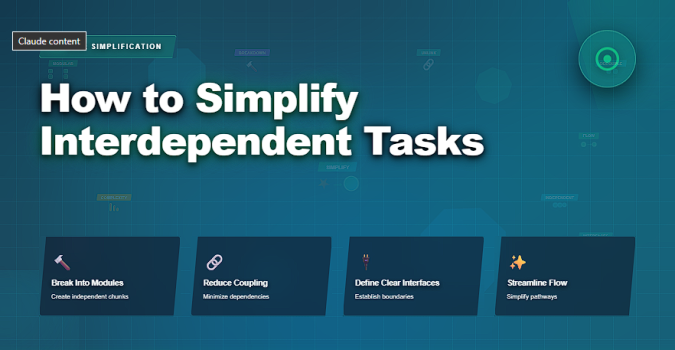
✔️ grouping tightly coupled tasks into logical work packages
✔️ reducing task-level approvals
✔️ sequencing work to protect scarce resources
✔️ limiting active work in progress
✔️ introducing clear integration points instead of continuous handoffs
✔️ separating “can start” from “must finish” dependencies
The goal is fewer handoffs, not less control.
✅ Using Milestones to Reduce Dependency Noise
Milestones can absorb complexity.
Instead of linking every task:
✔️ group tasks behind a milestone
✔️ track progress internally within teams
✔️ manage dependencies at milestone level
This reduces schedule noise while preserving visibility.
❌ Common Mistakes When Trying to Simplify
❌ removing dependencies without understanding the work
❌ oversimplifying tasks that require coordination
❌ collapsing tasks that need separate accountability
❌ ignoring resource-driven dependencies
❌ assuming fewer tasks always mean less risk
Simplification must improve flow — not hide risk.
⭐ Best Practices
✔️ design task breakdowns with dependency reduction in mind
✔️ visualize dependency chains regularly
✔️ challenge every dependency: “Is this required?”
✔️ protect flow over precision
✔️ review interdependence whenever scope changes
✔️ keep execution flexible within stable milestones
⭐ Final Thoughts
Interdependent tasks are not a failure of planning.
Unmanaged interdependence is.
Strong project managers simplify where possible, structure where necessary, and design schedules that reflect how work actually flows — not how it looks on paper.
Projects succeed not because everything is connected —
but because connections are intentional, minimal, and clear.