 MElkhateeb
➡️ Introduction
Schedules rarely fail because teams stop working.
They fail because performance is not tracked early or accurately.
Top 5 Project Management Software
Many projects rely on surface-level indicators like “percent complete” or optimistic status updates. These signals often hide delays until recovery becomes difficult or impossible. By the time a deadline is clearly missed, the opportunity to intervene has already passed.
Tracking schedule performance is not about reporting progress.
It is about detecting deviation early enough to act.
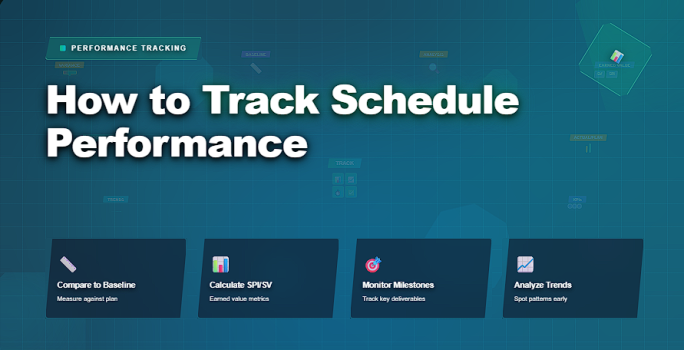
This article explains what schedule performance really means, which indicators matter most, and how project managers can track performance in a way that supports timely, informed decisions.
✅ What Schedule Performance Really Means
Schedule performance measures how actual progress compares to planned progress over time.
It answers critical questions such as:
✔️ Are we completing work at the rate we planned?
✔️ Is progress accelerating or slowing down?
✔️ Which parts of the schedule are slipping first?
✔️ Are delays isolated or systemic?
Schedule performance is about trend and direction, not single dates.
✅ Why Traditional Status Reporting Falls Short
Many schedules look “on track” until they are not.
Common weaknesses include:
✔️ relying on percent complete without context
✔️ tracking dates instead of progress rates
✔️ ignoring task sequencing and dependencies
✔️ masking delays with overtime
✔️ reporting status without forecasting impact
Effective tracking focuses on behavior, not appearance.
✅ Core Schedule Performance Indicators
Signals that reveal whether delivery is keeping pace with the plan.
| Indicator | What It Measures | Why It Matters |
|---|---|---|
| Planned vs Actual Progress | Work completed compared to baseline | Shows early deviation from plan |
| Schedule Variance | Difference between planned and actual timing | Reveals slippage trends |
| Critical Path Status | Progress of zero-float activities | Directly impacts finish date |
| Float Consumption | Loss of schedule flexibility | Signals growing schedule risk |
| Work-in-Progress Levels | Amount of active work at once | High WIP often slows delivery |
| Task Start/Finish Reliability | How often tasks start/finish as planned | Indicates planning realism |
✅ Using Earned Value Without Overcomplicating
For projects with sufficient maturity, Earned Value Management (EVM) can strengthen schedule tracking.
Key concepts:
✔️ Planned Value (PV)
✔️ Earned Value (EV)
✔️ Schedule Variance (SV)
✔️ Schedule Performance Index (SPI)
Used correctly, EVM shows whether progress matches time elapsed, not just effort spent. Used poorly, it adds noise. Simplicity matters.
✅ Turning Schedule Data into Action
Tracking performance only matters if it drives decisions.
Project managers should:
✔️ review trends weekly, not monthly
✔️ focus on leading indicators
✔️ escalate early when patterns emerge
✔️ adjust sequencing, not just deadlines
✔️ protect the critical path
✔️ rebalance workload proactively
Good tracking enables early correction, not late explanation.
❌ Common Mistakes in Schedule Performance Tracking
❌ tracking too many metrics
❌ focusing on lagging indicators
❌ accepting optimistic updates without validation
❌ ignoring dependency-driven delays
❌ compensating delays with overtime
❌ reporting status without forecasting impact
Measurement without interpretation is ineffective.
⭐ Best Practices
✔️ define what “on track” really means
✔️ track rate of progress, not just completion
✔️ monitor critical path continuously
✔️ make trends visible to the team
✔️ act on early signals
✔️ revisit baselines when justified
⭐ Final Thoughts
Schedule performance is not about proving the plan was right.
It is about keeping delivery realistic as reality unfolds.
Strong project managers track performance honestly, interpret trends early, and adjust intelligently. They treat schedules as living systems — not static promises.
Projects succeed not because schedules never change —
but because performance is understood before it’s too late.