 MElkhateeb
➡️ Introduction
Modern projects rarely fit neatly into one methodology.
Organizations today face fast-changing markets, evolving technologies, distributed teams, and increasing stakeholder expectations. As a result, project managers often discover that traditional frameworks like Waterfall or pure Agile methods like Scrum alone are not enough.
Top 5 Project Management Software
This is where Hybrid Project Management becomes essential.
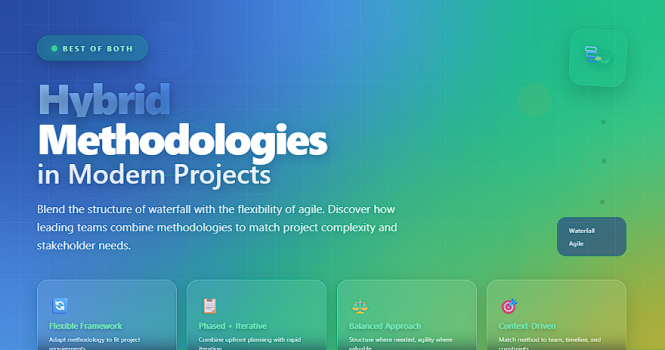
Hybrid methodologies combine the structure and predictability of traditional approaches with the flexibility and speed of Agile practices. When executed effectively, hybrid models help teams deliver faster, adapt better, and maintain the governance demanded by stakeholders.
This article breaks down what hybrid methodologies are, why they matter, and how to apply them — with a clear, responsive comparison table.
✅ What Are Hybrid Project Management Methodologies?
Hybrid methodologies integrate elements of Waterfall, Agile, or other frameworks to create a customized approach tailored to the project’s environment, constraints, and goals.
A hybrid model allows teams to:
✔️ use structured planning for predictable tasks
✔️ apply Agile for iterative or uncertain work
✔️ maintain governance without slowing innovation
✔️ adapt processes based on real feedback
This flexibility makes hybrid project management ideal for industries experiencing rapid change — such as technology, marketing, finance, and complex engineering.
✅ Why Hybrid Approaches Are Becoming Standard
Organizations increasingly choose hybrid methods because they offer the best of both worlds:
✔️ 1. Flexibility
Agile practices allow teams to adjust quickly as needs evolve.
✔️ 2. Predictability
Traditional planning (Gantt charts, baselines, stage gates) provides senior leaders with confidence and visibility.
✔️ 3. Faster Delivery
Work can begin on iterative components while long-term items follow structured plans.
✔️ 4. Balanced Stakeholder Requirements
Different stakeholders often have conflicting expectations. Hybrid methods help satisfy everyone.
✔️ 5. Improved Risk Management
Early Agile iterations reveal risks faster, while traditional controls help manage them more effectively.
✅ Common Hybrid Models in Project Management
A comparison of popular hybrid approaches and how they work.
| Hybrid Model | Description | Best For |
|---|---|---|
| Waterfall + Agile | Uses Waterfall for planning & major phases, with Agile sprints for development. | IT, software, digital marketing, and R&D. |
| Agile Inside Waterfall | Agile is used only within specific sub-teams while the overall project follows Waterfall. | Large enterprises & regulated industries. |
| Dual-Track Model | One track focuses on discovery & prototyping, while another executes delivery. | Products with uncertain requirements. |
| Scrum + Kanban (Scrumban) | Combines Scrum’s structure with Kanban’s continuous flow. | Support teams, DevOps, maintenance projects. |
✅ When Should You Use Hybrid Methods?
Hybrid approaches are most effective when:
✔️ requirements are partially known
✔️ stakeholders expect documentation and governance
✔️ technical work requires experimentation
✔️ the team includes both Agile and non-Agile roles
✔️ parts of the work are predictable, others are uncertain
✔️ leadership demands visibility with structured timelines
Most modern organizations fall into these categories, which is why hybrid frameworks are quickly becoming the global standard.
✅ Benefits of Hybrid Methodologies
✔️ 1. Structured Governance + Agile Flexibility
You maintain oversight while enabling innovation.
✔️ 2. Faster Risk Discovery
Iterative work reveals problems early.
✔️ 3. Higher Stakeholder Satisfaction
You meet both traditional and Agile expectations.
✔️ 4. Stronger Quality Control
Waterfall techniques support documentation; Agile supports frequent testing.
✔️ 5. Reduced Rework
Frequent feedback cycles prevent late-stage surprises.
✅ Challenges in Hybrid Project Management
Even though hybrid approaches are powerful, they require expert coordination.
❗ Mixed Skill Levels
Teams may not be familiar with both Agile and Waterfall.
❗ Conflicting Expectations
Some stakeholders expect detailed scope documents, while others expect Agile flexibility.
❗ Integration Complexity
Ensuring that iterative work fits into a structured schedule can be challenging.
❗ Risk of Misalignment
Without strong communication, hybrid teams may operate in silos.
✅ Best Practices for Successful Hybrid Projects
✔️ Define which parts of the project are Agile vs Waterfall
✔️ Establish a unified communication plan
✔️ Maintain one integrated schedule
✔️ Use dashboards for transparency
✔️ Assign a hybrid-experienced project manager
✔️ Set clear acceptance criteria
✔️ Conduct frequent milestone reviews
✔️ Document changes carefully
Successful hybrid projects require clarity, discipline, and flexibility.
⭐ Final Thoughts
Hybrid methodologies are no longer optional — they are becoming the default approach in modern project environments. By blending the predictability of traditional project management with the adaptability of Agile practices, hybrid models empower teams to deliver high-quality results faster and more efficiently.
Hybrid project management is not about choosing sides —
it’s about choosing what works.