 MElkhateeb
➡️ Introduction
Projects rarely fail because teams lack effort.
They fail because constraints surface too late.
Top 5 Project Management Software
By the time delays appear or budgets tighten, the real limitation has often existed from day one — hidden, ignored, or misunderstood. Time, cost, scope, resources, technology, regulations, and dependencies quietly shape what is possible long before execution begins.
Identifying project constraints early is not pessimism.
It is professional realism.
This article explains what project constraints really are, why early identification matters, and how project managers can systematically uncover constraints before they turn into schedule overruns, quality issues, or stakeholder conflict.
✅ What Project Constraints Really Are
A project constraint is anything that limits options or flexibility.
Constraints define the boundaries within which a project must operate. They do not disappear if ignored — they only become more expensive later.
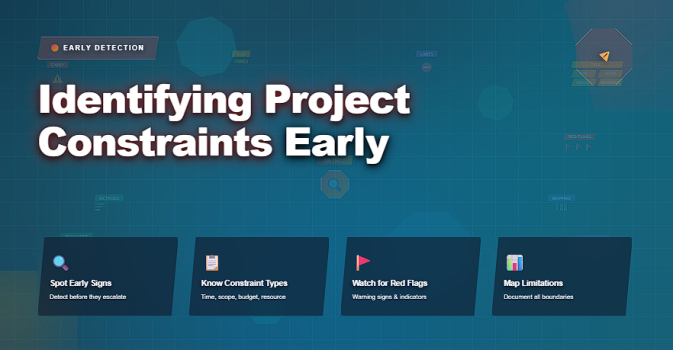
Common categories of constraints include:
✔️ time (deadlines, milestones)
✔️ cost (budget caps, funding timing)
✔️ scope (fixed requirements, contracts)
✔️ resources (people, skills, equipment)
✔️ technology (platforms, integrations)
✔️ regulations (compliance, approvals)
✔️ dependencies (vendors, teams, systems)
Constraints shape decisions even when they are not explicitly stated.
✅ Why Early Constraint Identification Matters
Constraints influence every planning decision.
When identified early, constraints:
✔️ guide realistic scheduling
✔️ prevent overcommitment
✔️ improve risk visibility
✔️ support better trade-offs
✔️ reduce rework and conflict
✔️ protect team credibility
When discovered late, constraints cause firefighting.
✅ Constraints vs Risks (Know the Difference)
Constraints and risks are often confused.
✔️ Constraints are known limitations that must be planned around
✔️ Risks are uncertain events that may or may not occur
A fixed deadline is a constraint.
A possible vendor delay is a risk.
Strong planning treats constraints as design inputs, not threats.
✅ Common Project Constraints and Early Detection
What to look for before planning commitments are made.
| Constraint Type | Early Warning Questions | Why It Matters |
|---|---|---|
| Time | Are there fixed deadlines or immovable milestones? | Limits scope and sequencing options |
| Budget | Is funding capped or phased? | Restricts resource and solution choices |
| Resources | Are key skills scarce or shared? | Creates hidden schedule bottlenecks |
| Scope | Are requirements contractually fixed? | Reduces flexibility under pressure |
| Technology | Are tools, platforms, or integrations mandated? | Limits technical solutions and pace |
| Dependencies | Does progress rely on external teams or vendors? | Introduces risks outside direct control |
✅ How to Uncover Constraints Early (Practical Techniques)
Effective project managers actively search for constraints.
Key techniques include:
✔️ structured stakeholder interviews
✔️ reviewing contracts and governance documents
✔️ validating assumptions with technical experts
✔️ mapping dependencies early
✔️ stress-testing initial schedules
✔️ asking “what cannot change?” explicitly
Silence often hides the strongest constraints.
✅ Making Constraints Visible and Actionable
Identifying constraints is only the first step.
They must be:
✔️ documented clearly
✔️ shared transparently
✔️ reviewed during planning
✔️ used to guide trade-offs
✔️ revisited as the project evolves
Constraints lose power when they are explicit and managed.
❌ Common Mistakes in Constraint Management
❌ assuming constraints will “sort themselves out”
❌ treating constraints as risks
❌ hiding constraints to gain approval
❌ discovering constraints during execution
❌ locking plans before constraints are validated
❌ ignoring resource constraints in schedules
Most project surprises are constraint failures, not execution failures.
⭐ Best Practices
✔️ identify constraints before committing to dates
✔️ separate constraints from assumptions
✔️ validate constraints with stakeholders
✔️ design plans around the tightest constraint
✔️ revisit constraints regularly
✔️ communicate constraints early and often
⭐ Final Thoughts
Constraints are not obstacles to success —
they are the reality of project work.
Strong project managers do not avoid constraints. They identify them early, plan around them deliberately, and use them to make better decisions.
Projects succeed not because constraints disappear —
but because they are understood before they cause damage.