 MElkhateeb
➡️ Introduction
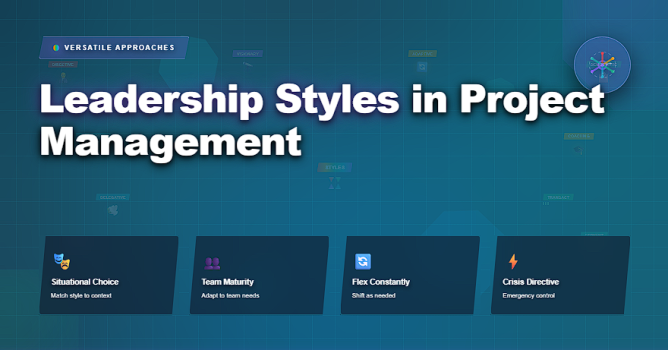
There is no single “best” leadership style in project management.
There is only the right style for the situation.
Top 5 Project Management Software
Projects operate under varying levels of uncertainty, pressure, maturity, and stakeholder influence. A leadership approach that works during early planning may fail during crisis recovery. A style that motivates senior specialists may frustrate junior teams.
Great project managers do not lead the same way all the time.
They adapt their leadership style intentionally based on context, team needs, and project risk.
This article explains the most important leadership styles in project management, how each one works, and when to use them to achieve the best results.
✅ Why Leadership Style Matters in Projects
Leadership style directly influences:
✔️ team motivation and trust
✔️ decision speed and quality
✔️ response to change and risk
✔️ stakeholder confidence
✔️ overall delivery performance
Using the wrong style at the wrong time creates friction — even with a strong plan.
✅ Leadership Style vs. Personality
Leadership style is not personality.
It is:
✔️ how decisions are made
✔️ how authority is exercised
✔️ how communication flows
✔️ how teams are supported or directed
Effective project leaders choose their style — they do not default to it.
✅ Leadership Styles Used in Project Management
How different leadership approaches impact project delivery.
| Leadership Style | How It Works | When It’s Most Effective |
|---|---|---|
| Directive Leadership | PM gives clear instructions and decisions | High-risk situations or crises |
| Coaching Leadership | PM develops people while guiding work | Skill-building and long-term growth |
| Participative Leadership | PM involves team in decisions | Complex problems requiring collaboration |
| Delegative Leadership | PM grants autonomy and trusts execution | Experienced, self-managing teams |
| Transformational Leadership | PM inspires through vision and purpose | Change initiatives and innovation projects |
✅ Choosing the Right Leadership Style
Effective project leaders consider:
✔️ team maturity and experience
✔️ project complexity and risk
✔️ time pressure
✔️ stakeholder expectations
✔️ organizational culture
Leadership style should evolve as the project evolves.
❌ Common Leadership Style Mistakes
❌ using the same style in every situation
❌ being overly directive with senior experts
❌ being too hands-off during crises
❌ confusing participation with lack of leadership
❌ avoiding difficult decisions to stay popular
Flexibility is the hallmark of strong leadership.
⭐ How Great Project Leaders Blend Styles
Great project leaders:
✔️ start directive when clarity is low
✔️ shift to participative as understanding grows
✔️ delegate as teams mature
✔️ coach to build long-term capability
✔️ inspire when change is required
Leadership becomes situational and intentional, not reactive.
⭐ A Simple Self-Assessment
Ask yourself:
✔️ What leadership style am I using right now?
✔️ Does it match the team’s needs today?
✔️ What would improve results if I adjusted my approach?
Awareness is the first step toward better leadership.
⭐ Final Thoughts
Leadership styles are tools — not identities.
The strongest project managers are not defined by one style.
They are defined by their ability to adapt, lead people through uncertainty, and deliver results under changing conditions.
In project management, leadership excellence comes from choosing the right style at the right time — consistently.