 MElkhateeb
➡️ Introduction
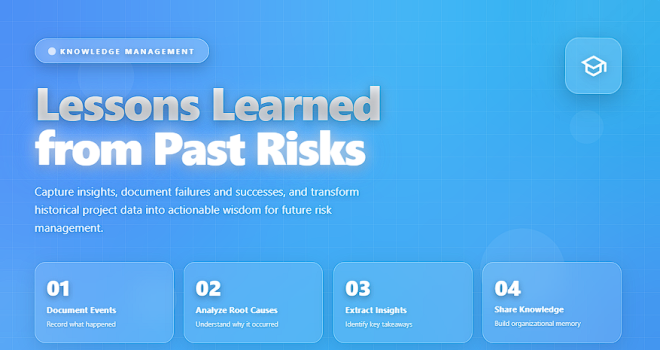
One of the most powerful ways to strengthen future project performance is to learn from risks that have already occurred. Whether a risk was successfully prevented or evolved into a major issue, each experience carries valuable insight that can protect future projects from repeating the same mistakes.
Top 5 Project Management Software
Organizations with a disciplined “lessons learned” process consistently:
✔️ improve project predictability
✔️ reduce preventable risks
✔️ mature their risk culture
✔️ accelerate decision-making
✔️ increase team confidence
This article explains how to capture lessons learned, what you should document, and how to use these insights to strengthen future risk management practices.
✅ What Are “Lessons Learned” in Risk Management?
Lessons learned are documented insights, observations, and conclusions from risks that:
- were identified but never occurred
- did occur but were managed successfully
- occurred and created major impact
- were missed entirely and appeared unexpectedly
The goal is simple:
Transform experience — good or bad — into repeatable improvements.
✅ Why Lessons Learned Matter
Lessons learned help project managers:
✔️ avoid repeating past mistakes
✔️ improve risk identification accuracy
✔️ strengthen mitigation planning
✔️ refine triggers and early warning indicators
✔️ improve team coordination
✔️ justify process changes to leadership
Organizations that capture lessons consistently reduce their risk exposure dramatically.
✅ Key Areas to Capture in Lessons Learned
Below is your responsive table showing what should be included when documenting past risk lessons.
✅ Key Areas to Document in Lessons Learned
What should you capture, analyze, and reuse in future projects?
| Area | What to Capture | Why It Matters |
|---|---|---|
| Risk Description | What happened or what was expected to happen. | Clarifies the context for future teams. |
| Root Cause | Underlying reason the risk occurred or almost occurred. | Prevents recurring patterns. |
| Impact Analysis | Cost, schedule, quality, or scope effects. | Shows severity and true consequences. |
| Response Effectiveness | Did the mitigation strategy work? | Highlights which actions are useful. |
| Successes | What the team did well. | Reinforces repeatable good practices. |
| Improvements Needed | What could be done better next time. | Forms actionable recommendations. |
| Future Recommendations | Guidance for upcoming projects. | Strengthens organizational maturity. |
✅ How to Capture Lessons Learned Effectively
✔️ 1. Start Early — Don’t Wait Until Project Closure
Lessons learned should be collected:
✔️ after major milestones
✔️ after risk events
✔️ during retrospectives
✔️ at critical decision points
Early capture prevents lost information.
✔️ 2. Involve the Entire Project Team
People closest to the work provide the best insight.
Include:
✔️ functional teams
✔️ technical leads
✔️ business stakeholders
✔️ vendors
✔️ PMO
The more perspectives, the richer the lessons.
✔️ 3. Use a Structured Template
A consistent format ensures clarity.
Document:
✔️ the risk
✔️ its cause
✔️ what was done
✔️ what worked
✔️ what failed
✔️ what should change
This creates organizational learning — not isolated memory.
✔️ 4. Analyze Trends Across Multiple Projects
Look for patterns like:
✔️ repeated vendor problems
✔️ recurring resource shortages
✔️ approval delays
✔️ poor change control
✔️ technical instability
Patterns reveal systemic issues needing strategic action.
✔️ 5. Store Lessons in a Central Repository
Avoid storing lessons in emails or personal folders.
A central location ensures:
✔️ accessibility
✔️ visibility
✔️ continuity between projects
✔️ reduced learning time
Examples:
- PMO knowledge base
- Confluence
- SharePoint
- Monday.com knowledge hub
✔️ 6. Convert Lessons into Improvements
The goal is not only documentation — it is action.
Improvements may include:
✔️ updating risk checklists
✔️ updating templates
✔️ adjusting estimates
✔️ changing vendor strategies
✔️ strengthening controls
✔️ improving communication plans
Lessons learned must lead to measurable change.
✔️ 7. Share Lessons Proactively
Share findings in:
✔️ kickoff meetings
✔️ planning workshops
✔️ risk review meetings
✔️ PMO governance sessions
This spreads knowledge and prevents repeating old mistakes.
❌ Common Mistakes to Avoid
❌ Saving lessons only at the end of the project
❌ Not identifying root causes
❌ Overlooking “small” risks
❌ Focusing only on failures instead of successes
❌ Not converting lessons into improvements
❌ Poor documentation and unclear recommendations
⭐ Best Practices
✔️ Make lessons learned a continuous practice
✔️ Encourage psychological safety — allow honest discussions
✔️ Focus on facts, not people
✔️ Use visual tools (heat maps, RCA diagrams)
✔️ Turn lessons into updated risk responses
✔️ Review lessons at every new project start
⭐ Final Thoughts
Lessons learned are one of the most valuable long-term assets in project management. They turn real-world experience into practical guidance that strengthens future planning, improves risk prevention, and builds organizational maturity.
Great project managers don’t just manage risks —
they learn, adapt, and improve with every risk they encounter.