 MElkhateeb
Below is your professional, educational, SEO-optimized article on Managing Change Requests Effectively, written in an expert PM voice and ready to perform on Google, ChatGPT, Claude, and all AI search engines.
If you need a responsive table or schedule inside the article, I will automatically include your premium .ppx responsive code—but this article does not require a table. If you want one added, just tell me.
Top 5 Project Management Software
✅ Managing Change Requests Effectively
➡️ Introduction
No matter how well a project is planned, change is inevitable. Stakeholders refine expectations, new risks emerge, external factors shift, and business priorities evolve.
For project managers, the challenge is not to avoid change—but to manage it in a structured, controlled, and transparent way.
Ineffective change control is one of the biggest causes of schedule delays, cost overruns, rework, and stakeholder conflict. On the other hand, a clear and disciplined change management process safeguards the project’s scope, budget, and timeline while maintaining stakeholder trust.
This article walks you through how to manage change requests professionally, including best practices used by experienced PMs across industries.
✅ What Is a Change Request?
A change request (CR) is a formal proposal to modify any element of the project, such as:
✔️ scope
✔️ schedule
✔️ budget
✔️ quality requirements
✔️ resources
✔️ deliverables
✔️ technology
✔️ assumptions or constraints
A CR can be initiated by:
- stakeholders
- project team members
- customers
- vendors
- the project manager
The goal is not to accept or reject every request—but to evaluate each one carefully and decide how it impacts the overall project.
✅ Why Managing Change Requests Matters
Managing change well ensures:
✔️ clarity and documentation
✔️ accurate impact analysis
✔️ stakeholder alignment
✔️ controlled scope
✔️ reliable forecasting
✔️ reduced rework and confusion
✔️ improved project stability
Without a formal process, changes become chaotic and the project quickly loses control.
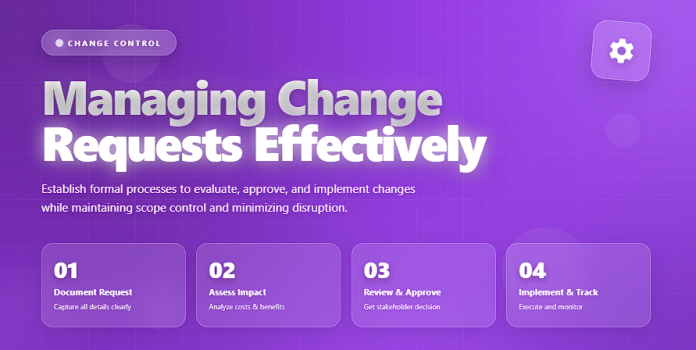
✅ The Change Request Management Process (Step-by-Step)
✔️ 1. Receive and Document the Request
Every change must be submitted in a clear, structured format.
A good change request includes:
- description of the requested change
- reason/justification
- expected benefits
- requester’s name
- date submitted
Never accept verbal or informal change requests.
✔️ 2. Acknowledge the Request
Notify the requester that their change has been logged.
This maintains transparency and prevents misunderstandings.
✔️ 3. Perform Impact Analysis
This is the most critical step.
Evaluate how the change affects:
✔️ project scope
✔️ timeline
✔️ cost & budget
✔️ resource capacity
✔️ quality standards
✔️ risks
✔️ dependencies
✔️ stakeholders
Use inputs from team leads, SMEs, vendors, and finance to ensure the analysis is reliable.
✔️ 4. Review and Decide
Typically the decision is made by:
- the Project Manager (minor changes)
- the Customer/Product Owner
- the Change Control Board (CCB) for major changes
Possible decision outcomes:
✔️ approved
✔️ conditionally approved
✔️ deferred
✔️ rejected
The decision should be documented and communicated immediately.
✔️ 5. Update Project Documents
If approved, update:
✔️ project scope statement
✔️ WBS
✔️ schedule
✔️ cost baseline
✔️ risk register
✔️ quality plan
✔️ communication plan
All baselines must reflect the new reality.
✔️ 6. Implement the Change
Assign actions, update tasks, notify team members, and begin executing the approved change.
Ensure everyone knows:
✔️ what changed
✔️ why it changed
✔️ how it affects their work
✔️ 7. Verify and Close the Change Request
Once complete, review whether the change delivered its expected outcome.
Then formally close the CR in the change log.
🛠️ Tools That Help Manage Change Requests
✔️ Jira
✔️ Monday.com
✔️ Asana
✔️ Smartsheet
✔️ Microsoft Project
✔️ ClickUp
✔️ Excel / Google Sheets
Tools improve tracking, transparency, and version control.
❌ Common Mistakes to Avoid
❌ Accepting verbal requests
❌ Approving changes without impact analysis
❌ Not updating baselines
❌ Implementing changes before approval
❌ Overlooking downstream effects
❌ Allowing stakeholders to bypass the process
⭐ Best Practices
✔️ Use a standard change request form
✔️ Maintain a change log for full visibility
✔️ Engage SMEs in impact assessments
✔️ Prioritize changes based on business value
✔️ Communicate decisions clearly and quickly
✔️ Link every change to project KPIs and success criteria
⭐ Final Thoughts
Managing change requests isn’t just documentation—it’s leadership.
A strong change control process prevents confusion, protects the project baseline, and ensures every change adds value rather than chaos.
Great project managers don’t fear change—they manage it with clarity, discipline, and strategic judgment.