 MElkhateeb
➡️ Introduction
Client changes are not the exception in projects.
They are the reality.
Top 5 Project Management Software
What turns client change into a problem is not the request itself — it is how the change is handled. When changes arrive unexpectedly and are absorbed informally, schedules slip, costs rise, and trust erodes on both sides.
Strong project managers do not try to eliminate client changes.
They manage them deliberately.
This article explains how to handle unforeseen client changes without losing control of scope, schedule, or relationships — and how to turn change into a managed decision instead of a hidden risk.
✅ Why Unforeseen Client Changes Happen
Unplanned client changes usually occur because:
✔️ business priorities shift
✔️ market conditions change
✔️ assumptions prove incorrect
✔️ users see early outputs and rethink needs
✔️ internal client alignment was incomplete
Change is not a failure of professionalism.
Ignoring its impact is.
✅ The Real Risk of Poor Change Handling
When client changes are accepted informally:
✔️ scope expands without visibility
✔️ timelines stretch silently
✔️ teams absorb extra work without capacity checks
✔️ estimates lose credibility
✔️ disputes arise late
The project appears cooperative — until delivery breaks.
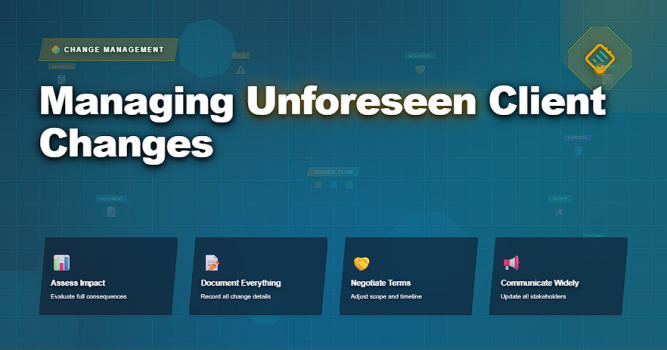
✅ How to Manage Unforeseen Client Changes
A practical framework to protect scope, schedule, and trust.
| Step | What to Do | Why It Matters |
|---|---|---|
| Acknowledge the Request | Listen and document the change clearly | Prevents misunderstanding |
| Pause Commitment | Avoid immediate approval or rejection | Protects planning integrity |
| Assess Impact | Analyze scope, schedule, cost, and risk | Makes trade-offs visible |
| Present Options | Offer alternatives with clear consequences | Enables informed decisions |
| Formalize the Decision | Document approval and update baselines | Restores accountability |
✅ How to Communicate Client Changes Effectively
Effective communication during change requires:
✔️ neutral, factual language
✔️ focus on impact, not blame
✔️ clarity on trade-offs
✔️ consistency across stakeholders
✔️ written confirmation after discussion
Clients respect clarity more than silent accommodation.
❌ Common Mistakes When Handling Client Changes
❌ saying “yes” to be helpful
❌ absorbing work without analysis
❌ hiding impact to protect relationships
❌ delaying formal documentation
❌ treating frequent changes as normal noise
These mistakes convert flexibility into risk.
⭐ Best Practices for Managing Client Changes
✔️ establish change rules early
✔️ maintain a visible change log
✔️ link changes to baselines
✔️ protect team capacity
✔️ re-forecast after significant changes
✔️ revisit priorities regularly
Change management is a leadership discipline.
⭐ Final Thoughts
Unforeseen client changes are inevitable.
Loss of control is not.
Strong project managers do not resist change —
they structure it, analyze it, and manage it transparently.
Projects succeed not because clients never change their minds —
but because changes are handled with clarity, discipline, and mutual respect.