 MElkhateeb
➡️ Introduction
Risk is not the enemy of projects.
Unplanned risk is.
Top 5 Project Management Software
Most project failures are not caused by unexpected events, but by predictable risks that were never planned for properly. Poor estimates, vague scope, fragile dependencies, and unrealistic assumptions quietly accumulate until the schedule, budget, or team breaks.
Better planning does not eliminate risk.
It reduces exposure, limits impact, and creates options when things go wrong.
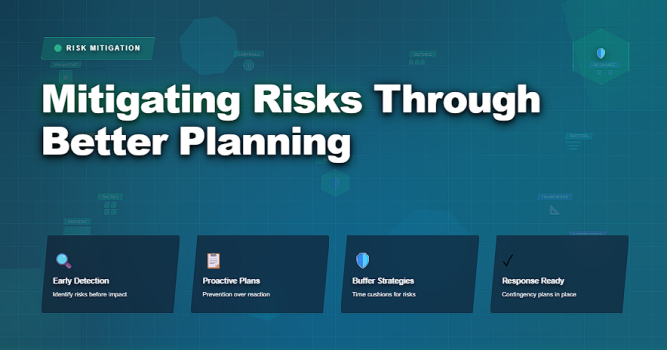
This article explains how strong project planning actively mitigates risk, which planning elements matter most, and how project managers can design plans that remain stable under uncertainty.
✅ What Does Risk Mitigation Mean in Planning?
Risk mitigation through planning means designing the project structure in a way that reduces the likelihood and impact of negative events.
It focuses on:
✔️ anticipating uncertainty
✔️ strengthening weak points
✔️ reducing dependency fragility
✔️ building recovery options
✔️ protecting critical objectives
Good planning does not assume success.
It prepares for variation.
✅ Why Poor Planning Increases Risk
Weak plans amplify risk instead of controlling it.
Common planning weaknesses include:
❌ vague scope definitions
❌ optimistic timelines
❌ missing dependencies
❌ overloaded resources
❌ no contingency time
❌ unclear decision authority
When risk appears, these plans have no flexibility — only reactions.
✅ Planning Areas That Have the Greatest Impact on Risk
Not all planning activities reduce risk equally. The highest leverage areas are:
✔️ scope clarity and boundaries
✔️ realistic scheduling and sequencing
✔️ dependency management
✔️ resource capacity planning
✔️ risk-informed buffers
✔️ stakeholder decision timing
Improving these areas dramatically lowers project volatility.
✅ How Better Planning Mitigates Project Risk
Key planning actions that reduce uncertainty and protect delivery.
| Planning Area | What to Do | Risk Reduced |
|---|---|---|
| Scope Definition | Define inclusions, exclusions, and assumptions clearly | Scope creep and rework |
| Schedule Logic | Build realistic dependencies and sequencing | Hidden critical paths |
| Resource Planning | Assign work based on capacity, not titles | Overload and burnout |
| Contingency Time | Add buffers tied to identified risks | Schedule slippage |
| Dependency Control | Minimize handoffs and external reliance | Delay propagation |
| Decision Planning | Schedule approvals and escalation paths | Waiting time and stalled progress |
✅ How Planning Reduces Risk During Execution
Strong plans continue to mitigate risk after kickoff by:
✔️ revealing early warning signals
✔️ enabling faster trade-off decisions
✔️ preventing silent overload
✔️ maintaining realistic expectations
✔️ supporting proactive re-planning
Execution becomes controlled adjustment, not constant firefighting.
❌ Common Planning Mistakes That Increase Risk
❌ planning only for the happy path
❌ hiding contingency inside task estimates
❌ ignoring dependency complexity
❌ assuming resources are always available
❌ delaying risk discussions until issues appear
These mistakes convert manageable risks into crises.
⭐ Best Practices
✔️ treat planning as risk design, not documentation
✔️ separate base plans from protection mechanisms
✔️ review risks alongside schedules
✔️ re-plan when assumptions change
✔️ protect milestones, not individual tasks
✔️ communicate risk logic clearly to stakeholders
⭐ Final Thoughts
Mitigating risk through better planning is not about adding complexity.
It is about removing fragility.
Strong project managers understand that planning is the first and most powerful form of risk control.
Projects succeed not because nothing goes wrong —
but because the plan was strong enough to handle what did.