 MElkhateeb
➡️ Introduction
Motivation is not about pushing people harder.
It is about understanding what drives behavior.
Top 5 Project Management Software
Many managers rely on assumptions when trying to motivate teams — higher pay, tighter deadlines, or constant encouragement. While these tactics may work briefly, they often fail to sustain performance.
Effective managers understand that motivation is predictable. Decades of research have identified clear patterns that explain why people engage, disengage, or perform at their best.
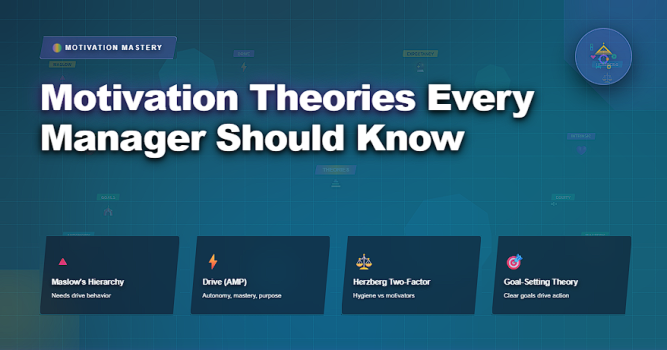
This article explains the most important motivation theories every manager should know — and, more importantly, how to apply them in real work environments.
✅ Why Managers Must Understand Motivation Theories
Motivation theories help managers:
✔️ avoid one-size-fits-all approaches
✔️ design work that engages people naturally
✔️ reduce burnout and disengagement
✔️ improve performance sustainably
✔️ make better leadership decisions
Without this understanding, managers often confuse pressure with motivation.
✅ Key Motivation Theories for Managers
What actually drives people at work.
| Theory | Main Idea | Practical Application |
|---|---|---|
| Maslow’s Hierarchy of Needs | People seek to satisfy needs in stages | Ensure safety, belonging, and growth opportunities |
| Herzberg’s Two-Factor Theory | Satisfaction and dissatisfaction come from different factors | Improve work itself, not just pay or policies |
| McClelland’s Needs Theory | People are driven by achievement, power, or affiliation | Align roles with dominant motivational needs |
| Expectancy Theory | Effort depends on belief in results and rewards | Clarify goals, effort, and outcomes |
| Self-Determination Theory | Autonomy, mastery, and purpose drive motivation | Give autonomy and meaningful work |
✅ How Managers Apply These Theories in Practice
Effective managers:
✔️ recognize that motivation differs by individual
✔️ design roles that align with natural drivers
✔️ focus on meaningful work, not just incentives
✔️ create clarity around goals and rewards
✔️ support growth and autonomy
Motivation improves when work is designed intentionally.
❌ Common Motivation Mistakes Managers Make
❌ assuming money motivates everyone equally
❌ using pressure as a default tool
❌ ignoring individual needs and drivers
❌ rewarding effort instead of outcomes
❌ failing to explain the “why” behind work
These mistakes create compliance, not commitment.
⭐ A Simple Motivation Check for Managers
Ask yourself:
✔️ Do team members understand how their work matters?
✔️ Do they have control over how they achieve results?
✔️ Are rewards aligned with effort and performance?
If not, motivation will remain fragile.
⭐ Final Thoughts
Motivation is not a mystery — it is a management skill.
Managers who understand motivation theories stop guessing and start leading with intention. They create environments where people are energized, focused, and committed — not because they are forced to work harder, but because the work itself makes sense and feels worthwhile.
Great managers do not motivate people directly.
They design conditions where motivation naturally emerges.