 MElkhateeb
➡️ Introduction
Scheduling has become one of the most critical capabilities for organizations in 2025.
With distributed teams, shared resources, tighter deadlines, and increasing delivery pressure, the way work is scheduled directly affects productivity, cost control, and team wellbeing.
Top 5 Project Management Software
Modern scheduling tools are no longer simple calendars. They are decision-support systems that help organizations coordinate tasks, people, and time across multiple projects and teams.
Choosing the right scheduling tool can mean the difference between predictable delivery and constant firefighting.
This article provides an overview of the top scheduling tools in 2025, explains how they differ by use case, and outlines what project managers and organizations should consider when selecting a scheduling solution.
✅ Why Scheduling Tools Matter More Than Ever in 2025
Organizations today face scheduling challenges that did not exist a decade ago:
✔️ hybrid and remote work environments
✔️ shared specialists across multiple projects
✔️ frequent scope and priority changes
✔️ higher dependency between teams
✔️ limited resource availability
✔️ increased expectations for speed and transparency
Manual scheduling methods struggle under this complexity. Modern scheduling tools address these challenges by offering:
✔️ real-time visibility into workloads
✔️ automated conflict detection
✔️ dependency-aware timelines
✔️ capacity-based planning
✔️ integrations with work and communication platforms
Scheduling tools have become essential for maintaining control and predictability.
✅ Categories of Scheduling Tools
Not all scheduling tools serve the same purpose. In 2025, scheduling software generally falls into three main categories.
📌 Project & Resource Scheduling Tools
These tools focus on tasks, timelines, dependencies, and resource utilization. They are widely used by project managers, PMOs, and operations teams.
Typical capabilities include:
✔️ Gantt charts and timeline views
✔️ dependency management
✔️ resource allocation and utilization tracking
✔️ workload visualization
✔️ progress forecasting
These tools are best suited for managing complex, multi-phase projects.
📌 Workforce & Shift Scheduling Tools
Workforce scheduling tools are designed to manage people-centric schedules, especially for shift-based environments.
They typically support:
✔️ shift planning and coverage
✔️ availability and time-off tracking
✔️ compliance and labor rules
✔️ real-time schedule updates
✔️ mobile access for frontline teams
These tools are common in retail, healthcare, hospitality, and service operations.
📌 Appointment & Service Scheduling Tools
Appointment scheduling tools focus on booking time with clients or internal stakeholders.
Key features usually include:
✔️ self-service booking
✔️ calendar synchronization
✔️ automated reminders
✔️ time-zone handling
✔️ customer notifications
They are ideal for service providers, consultants, trainers, and small businesses.
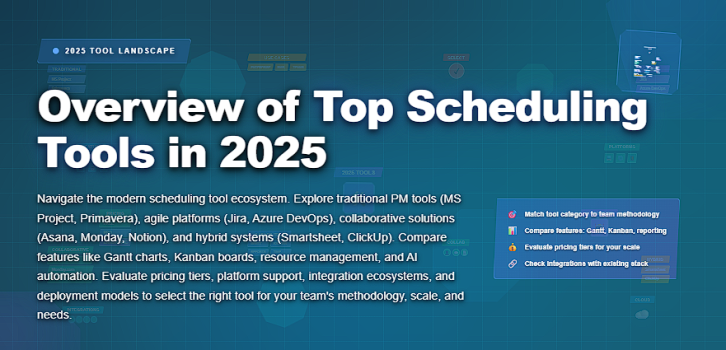
➡️ Overview of Top Scheduling Tools in 2025
✅ What to Look for in a Scheduling Tool in 2025
When evaluating scheduling software, project managers should focus on:
✔️ Capacity awareness – can the tool reflect real availability?
✔️ Dependency handling – does it manage task relationships?
✔️ Automation – does it reduce manual scheduling work?
✔️ Visibility – can stakeholders see schedules clearly?
✔️ Scalability – will it still work as projects grow?
✔️ Integration – can it connect with existing systems?
The “best” tool is the one that aligns with how your organization actually works.
✅ Common Mistakes When Choosing Scheduling Tools
❌ selecting tools based on popularity, not need
❌ underestimating future complexity
❌ ignoring resource constraints
❌ choosing tools that teams won’t adopt
❌ relying on scheduling without capacity tracking
❌ assuming one tool fits all scheduling scenarios
Avoiding these mistakes saves time, money, and frustration.
⭐ Best Practices
✔️ match the tool to the scheduling problem
✔️ start simple, then scale functionality
✔️ involve end users in selection
✔️ integrate scheduling with workload data
✔️ review scheduling effectiveness regularly
✔️ treat scheduling as a management system, not a calendar
⭐ Final Thoughts
Scheduling tools in 2025 are no longer optional utilities — they are core operational systems.
When used correctly, they help organizations:
✔️ align workload with deadlines
✔️ reduce conflicts and bottlenecks
✔️ improve delivery predictability
✔️ protect teams from overload
✔️ support strategic decision-making
Great project managers don’t just schedule tasks.
They design scheduling systems that balance time, capacity, and priorities — even in complex environments.