 MElkhateeb
➡️ Introduction
Most project plans do not fail because teams lack discipline.
They fail because the environment changes faster than the plan.
Top 5 Project Management Software
Market conditions shift. Stakeholder priorities evolve. Technology introduces uncertainty. Regulations change. Dependencies move. Teams learn new information mid-execution.
Flexible planning is not about abandoning structure.
It is about designing plans that can absorb change without collapsing.
This article explains how flexible planning works in changing environments, why rigid plans break under uncertainty, and how project managers can create planning systems that adapt while remaining predictable and controlled.
✅ What Flexible Planning Really Means
Flexible planning does not mean vague planning.
It means:
✔️ planning with assumptions, not certainties
✔️ separating direction from detail
✔️ committing in short horizons
✔️ revisiting plans as knowledge increases
✔️ adjusting scope before adjusting dates
Flexible planning accepts uncertainty as a design input, not a failure.
✅ Why Traditional Plans Break in Dynamic Environments
Rigid plans struggle when:
✔️ requirements are unclear upfront
✔️ stakeholders change expectations midstream
✔️ dependencies shift outside team control
✔️ learning happens during execution
✔️ risk materializes earlier than expected
Traditional plans assume stability.
Changing environments demand adaptability by design.
✅ What Must Stay Stable vs What Must Stay Flexible
Not everything should change.
Strong planning distinguishes between anchors and variables.
Stable Elements
✔️ project purpose
✔️ success criteria
✔️ governance rules
✔️ major milestones
✔️ quality standards
Flexible Elements
✔️ detailed scope
✔️ solution approach
✔️ task sequencing
✔️ priorities within iterations
✔️ delivery tactics
Flexibility without anchors creates chaos.
Anchors without flexibility create fragility.
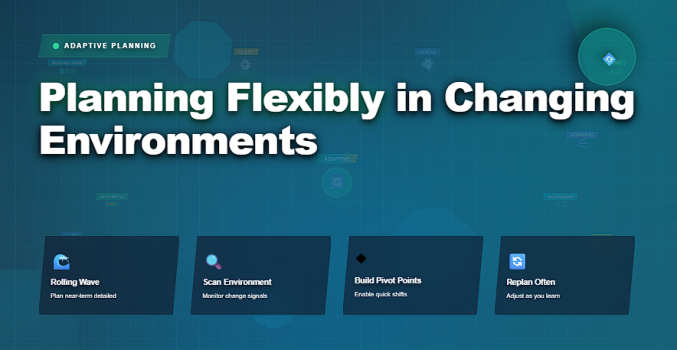
✅ Planning Flexibly in Changing Environments
How to stay adaptable without losing control or credibility.
| Planning Area | Traditional Approach | Flexible Planning Approach |
|---|---|---|
| Scope | Fixed upfront | Evolving within constraints |
| Timeline | Single fixed forecast | Rolling forecasts with confidence ranges |
| Detail Level | High detail early | Progressive elaboration |
| Risk Handling | Static risk register | Continuous risk reassessment |
| Decision Timing | Early commitments | Just-in-time decisions |
| Change Response | Reactive re-planning | Built-in adaptation loops |
✅ Practical Techniques for Flexible Planning
Effective flexible planning relies on a few disciplined practices:
✔️ short planning horizons with frequent reviews
✔️ rolling-wave planning
✔️ scenario-based forecasting
✔️ explicit assumption tracking
✔️ visible contingency buffers
✔️ prioritization based on value and risk
Flexibility comes from structure, not from improvisation.
✅ Role of the Project Manager in Dynamic Environments
In changing environments, project managers act as sense-makers, not just planners.
Key responsibilities include:
✔️ detecting early signals of change
✔️ facilitating trade-off discussions
✔️ protecting teams from unnecessary churn
✔️ updating stakeholders with confidence ranges
✔️ maintaining alignment on goals
✔️ ensuring decisions remain reversible when possible
The focus shifts from “following the plan” to keeping the plan relevant.
❌ Common Mistakes in Flexible Planning
❌ changing plans without explaining why
❌ reacting to noise instead of signals
❌ removing all structure in the name of agility
❌ hiding uncertainty from stakeholders
❌ adjusting dates before adjusting scope
❌ re-planning too frequently without learning
Flexibility without discipline quickly becomes instability.
⭐ Best Practices
✔️ plan in layers
✔️ commit in short cycles
✔️ review assumptions regularly
✔️ communicate uncertainty clearly
✔️ protect delivery focus
✔️ design plans for change, not against it
⭐ Final Thoughts
Flexible planning is not about predicting change —
it is about being ready when change arrives.
Strong project managers design plans that can bend without breaking. They combine clarity of purpose with adaptability of execution.
Projects succeed in changing environments not because plans are perfect —
but because they are resilient.