 MElkhateeb
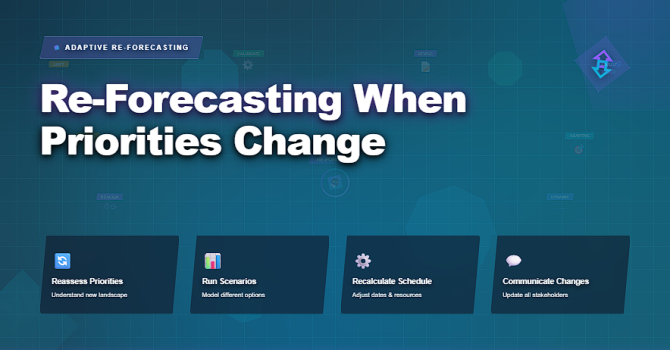
➡️ Introduction
Priorities change.
Forecasts must change with them — but not impulsively.
Top 5 Project Management Software
In many projects, shifting priorities trigger rushed re-planning: dates are moved, resources reshuffled, and expectations reset without fully understanding the consequences. The result is confusion, credibility loss, and a forecast no one truly trusts.
Re-forecasting is not about reacting faster.
It is about restoring realism after direction changes.
This article explains when re-forecasting is necessary, how to do it without destabilizing delivery, and how project managers can maintain confidence and control while priorities evolve.
✅ When Re-Forecasting Is Truly Required
Not every change deserves a new forecast.
Re-forecasting is necessary when:
✔️ strategic objectives shift
✔️ priority work displaces planned work
✔️ resource allocation changes materially
✔️ delivery sequencing is altered
✔️ risk exposure increases significantly
Re-forecasting is a decision-making reset, not a routine update.
✅ Why Priority Changes Break Forecasts
Forecasts are built on assumptions.
When priorities change, assumptions break:
✔️ what work is most important
✔️ which resources are available
✔️ which deadlines matter most
✔️ which risks are acceptable
Continuing with the old forecast after a priority shift creates false certainty.
✅ Re-Forecasting Framework
How to realign forecasts after priorities shift.
| Step | What to Re-Evaluate | Why It Matters |
|---|---|---|
| Confirm New Priorities | What now matters most | Sets forecasting direction |
| De-Prioritize Displaced Work | What moves, pauses, or drops | Prevents hidden overload |
| Reassess Capacity | Actual available effort | Avoids optimistic timelines |
| Update Sequencing | Dependencies and logic | Preserves schedule integrity |
| Re-Forecast Dates | New realistic milestones | Restores credibility |
| Communicate Impacts | Expectations and trade-offs | Maintains alignment and trust |
✅ Re-Forecasting Without Constant Resetting
Frequent re-forecasting creates instability.
To avoid this:
✔️ separate strategic changes from noise
✔️ batch priority updates where possible
✔️ define a minimum stabilization period
✔️ protect teams from daily direction shifts
✔️ maintain a clear “current forecast” version
Stability is as important as accuracy.
✅ Communicating Re-Forecasts to Stakeholders
A re-forecast is not just new dates.
Stakeholders need:
✔️ the reason for the change
✔️ what assumptions changed
✔️ what trade-offs were made
✔️ what remains unchanged
✔️ what decisions are now required
Clarity prevents skepticism.
❌ Common Re-Forecasting Mistakes
❌ changing forecasts without stopping other work
❌ stacking priorities instead of replacing them
❌ compressing timelines to satisfy pressure
❌ re-forecasting without resource validation
❌ failing to document assumptions
Re-forecasting fails when honesty is sacrificed for optimism.
⭐ Best Practices
✔️ re-forecast only when priorities truly change
✔️ treat re-forecasting as a leadership action
✔️ anchor forecasts in capacity, not hope
✔️ preserve logic and dependencies
✔️ communicate trade-offs explicitly
✔️ stabilize before optimizing
⭐ Final Thoughts
Re-forecasting is not a correction —
it is a realignment.
Strong project managers do not pretend priorities stayed the same. They update forecasts deliberately, transparently, and with respect for capacity and reality.
Projects succeed not because priorities never change —
but because forecasts change without losing control.