 MElkhateeb
➡️ Introduction
Delays are not the real problem in projects.
Poor re-planning is.
Top 5 Project Management Software
Unexpected delays happen in every environment — IT, construction, operations, product development, and transformation programs. What determines success is not whether a delay occurs, but how quickly and intelligently the project is re-planned afterward.
Many teams respond to delays by pushing dates, adding pressure, or demanding faster execution. These reactions often make the situation worse.
This article explains how to re-plan effectively after unexpected delays, restore control, and protect delivery credibility without creating chaos.
✅ Why Re-Planning Requires a Different Mindset
Re-planning is not about “catching up.”
It is about resetting reality.
After a delay:
✔️ original assumptions are no longer valid
✔️ dependencies may have shifted
✔️ resource availability may have changed
✔️ risks may have increased
✔️ stakeholder expectations must be reset
Continuing with the original plan after a major delay creates false confidence.
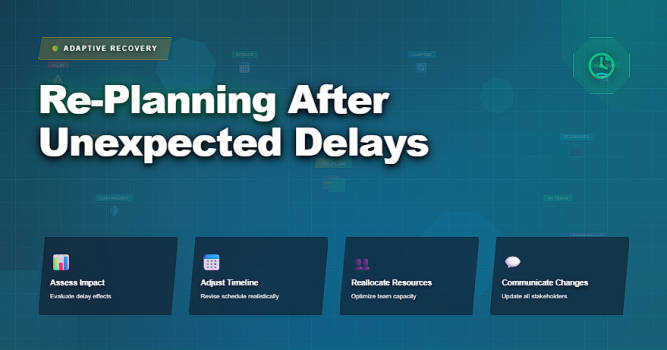
✅ Re-Planning After a Delay: Practical Framework
How to regain control without increasing risk.
| Step | What to Do | Why It Matters |
|---|---|---|
| Acknowledge the Delay | Confirm impact using actual data | Prevents denial-based planning |
| Stabilize the Situation | Pause non-critical work temporarily | Stops further disruption |
| Revalidate Dependencies | Review task sequencing and handoffs | Avoids hidden blockers |
| Reforecast Durations | Estimate remaining work realistically | Creates credible timelines |
| Assess Capacity | Confirm actual resource availability | Prevents overload |
| Set a New Baseline | Agree on revised dates formally | Restores accountability |
✅ What Not to Do After a Delay
Re-planning fails when teams:
❌ compress tasks without analysis
❌ add overtime as a default solution
❌ skip dependency reviews
❌ hide impact from stakeholders
❌ keep the old baseline “for reference”
These actions increase risk instead of reducing it.
⭐ How Strong Project Managers Handle Re-Planning
Effective project managers:
✔️ separate facts from emotions
✔️ protect the critical path
✔️ escalate trade-offs early
✔️ communicate clearly and calmly
✔️ reset expectations transparently
✔️ focus on flow, not speed
Re-planning is a leadership moment.
⭐ Key Takeaways
✔️ Delays invalidate original assumptions
✔️ Re-planning must be deliberate and structured
✔️ Dependency clarity is essential
✔️ Capacity limits still apply
✔️ A new baseline restores control
⭐ Final Thoughts
Unexpected delays do not define a project’s failure.
Poor recovery does.
Re-planning is not about working harder or moving faster.
It is about making smarter decisions with updated information.
Projects succeed not because delays never occur —
but because teams respond to them with discipline, clarity, and leadership.