 MElkhateeb
➡️ Introduction
Effective timelines are not about perfect predictions.
They are about making time visible, manageable, and adjustable.
Top 5 Project Management Software
Across industries, projects that finish on time tend to share a common trait: their timelines are built to support decision-making, not just reporting. They reflect reality, highlight dependencies, and evolve as conditions change.
This article presents real-world examples of effective timelines and explains why they worked — so project managers can apply the same principles in their own projects.
✅ What Makes a Timeline “Effective” in Practice
An effective timeline does not aim to impress stakeholders.
It aims to guide execution.
Strong timelines typically:
✔️ focus on milestones, not excessive detail
✔️ make dependencies explicit
✔️ reflect real capacity
✔️ surface risks early
✔️ support frequent re-forecasting
The examples below illustrate these principles in action.
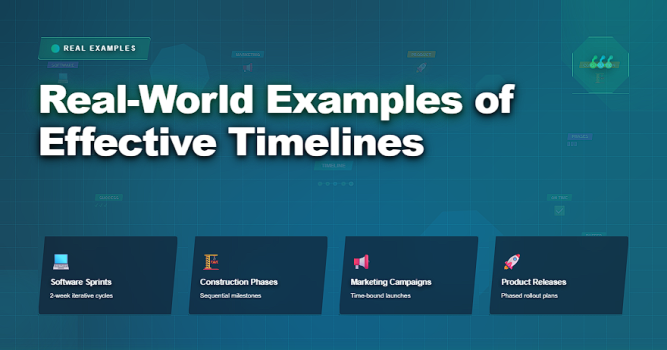
✅ Real-World Timeline Examples
How effective timelines supported on-time delivery.
| Project Type | Timeline Approach | Why It Worked |
|---|---|---|
| Retail Store Rollout | Milestone-based timeline with fixed opening dates | Forced early prioritization and dependency clarity |
| IT System Upgrade | Phased delivery with buffer between testing and release | Absorbed defects without slipping go-live |
| Construction Project | Critical-path focused schedule with weekly re-forecasting | Detected slippage early and protected handovers |
| Agile Product Launch | Release roadmap updated every sprint | Maintained predictability despite scope changes |
| Marketing Campaign | Backwards planning from launch date | Ensured all approvals completed on time |
✅ Common Patterns Across Successful Timelines
Across these examples, several patterns repeat:
✔️ timelines built around decisions, not tasks
✔️ clear visibility of dependencies
✔️ realistic capacity assumptions
✔️ explicit buffers at risk points
✔️ frequent, lightweight updates
The format differed — the discipline did not.
❌ What These Projects Avoided
These projects deliberately avoided:
❌ over-detailed schedules that no one updated
❌ treating initial plans as fixed promises
❌ hiding slippage until milestones were missed
❌ relying on heroics to recover time
❌ confusing activity with progress
Avoidance mattered as much as design.
⭐ Lessons Project Managers Can Apply Immediately
✔️ design timelines for visibility, not perfection
✔️ anchor plans to milestones and constraints
✔️ review timelines regularly, not occasionally
✔️ treat updates as normal, not failure
✔️ use timelines as conversation tools
An effective timeline is used, not admired.
⭐ Final Thoughts
Real-world timelines succeed because they reflect reality and evolve with it.
They do not predict the future perfectly —
they create the conditions to respond to it intelligently.
Projects succeed not because timelines never change —
but because they change early, visibly, and deliberately.