 MElkhateeb
➡️ Introduction
Great performance does not sustain itself.
It is reinforced — or slowly lost.
Top 5 Project Management Software
Many teams work hard, deliver results, and move on without acknowledgment. Over time, effort becomes invisible, motivation fades, and high performers disengage. Recognition is often treated as optional or informal, yet it is one of the most powerful tools leaders have to shape behavior and performance.
Recognizing and rewarding great performance is not about generosity.
It is about clarity, fairness, and reinforcement.
This article explains what effective recognition really means, why it matters, and how leaders can reward performance in ways that are meaningful, consistent, and sustainable.
✅ What Recognition and Reward Really Mean
Recognition acknowledges behavior and contribution.
Rewards reinforce impact and outcomes.
Effective recognition:
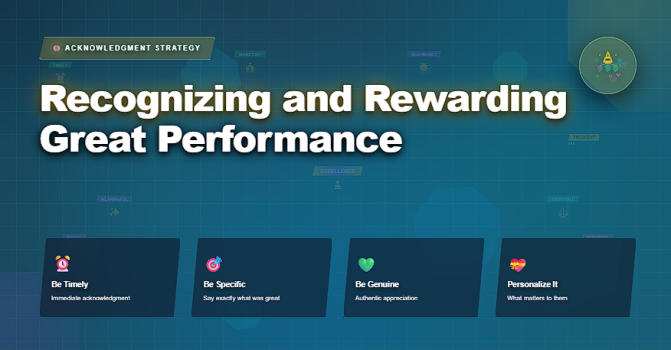
✔️ is timely
✔️ is specific
✔️ is fair and consistent
✔️ connects effort to results
Effective rewards:
✔️ align with what the team values
✔️ reinforce desired behaviors
✔️ support long-term motivation
Recognition without meaning feels empty.
Rewards without clarity feel unfair.
✅ Why Recognition Drives Performance
When recognition is done well:
✔️ motivation increases
✔️ engagement improves
✔️ trust in leadership strengthens
✔️ high performers stay committed
✔️ positive behaviors spread across the team
When recognition is absent, people stop giving discretionary effort — quietly.
✅ Practical Recognition and Reward Methods
What reinforces performance effectively.
| Approach | What It Recognizes | Why It Works |
|---|---|---|
| Public Recognition | Visible contribution and impact | Reinforces positive behavior socially |
| Private Appreciation | Personal effort and commitment | Builds trust and loyalty |
| Growth Opportunities | Capability and potential | Motivates long-term engagement |
| Increased Autonomy | Reliability and competence | Signals trust and respect |
| Meaningful Rewards | Results aligned with goals | Connects performance to outcomes |
✅ What Makes Recognition Effective
Recognition works best when it is:
✔️ timely — close to the achievement
✔️ specific — clearly tied to behavior or result
✔️ consistent — applied fairly across the team
✔️ aligned — connected to team values and goals
Vague praise does not reinforce behavior.
Specific recognition does.
❌ Common Mistakes Leaders Make with Recognition
❌ recognizing only final results
❌ rewarding visibility instead of impact
❌ overusing generic praise
❌ ignoring quiet high performers
❌ being inconsistent or biased
Poor recognition damages trust faster than no recognition at all.
⭐ How Leaders Build a Culture of Recognition
Effective leaders:
✔️ make recognition a regular habit
✔️ highlight behaviors they want repeated
✔️ tailor rewards to individual motivators
✔️ encourage peer recognition
✔️ link recognition to shared goals
Recognition becomes culture when it is predictable and authentic.
⭐ A Simple Recognition Check for Leaders
Ask yourself:
✔️ Do people know what great performance looks like?
✔️ Is recognition tied to clear outcomes or behaviors?
✔️ Are high performers consistently acknowledged?
If not, motivation risk is increasing.
⭐ Final Thoughts
Recognizing and rewarding great performance is not about being generous.
It is about being intentional.
People repeat what leaders reinforce.
When effort, quality, and collaboration are recognized consistently, performance becomes sustainable — not accidental.
Great leaders do not wait for annual reviews to say “well done.”
They build recognition into everyday leadership.