 MElkhateeb
➡️ Introduction
Projects rarely miss deadlines without warning.
They miss deadlines because early signals are ignored, misread, or normalized.
Top 5 Project Management Software
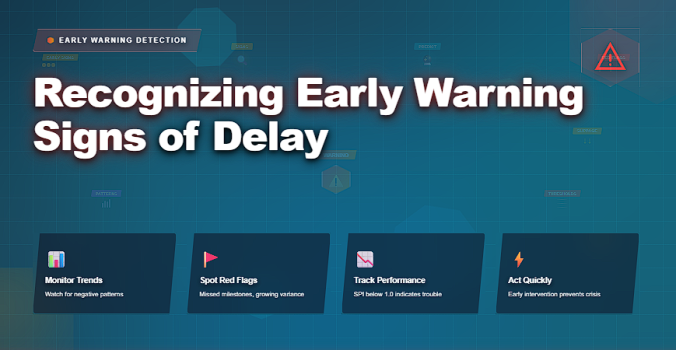
Before a schedule slips visibly, subtle changes begin to appear — small delays, growing work-in-progress, stretched dependencies, and quiet behavioral shifts in the team. These signals often look harmless in isolation. Together, they form a clear pattern.
Recognizing early warning signs of delay is not about pessimism.
It is about situational awareness.
This article explains what early warning signs really look like, why they are often dismissed, and how project managers can detect and act on them before recovery options narrow.
✅ What an Early Warning Sign Really Is
An early warning sign is any deviation from expected schedule behavior, even if delivery dates have not changed yet.
These signs appear as:
✔️ trends, not events
✔️ patterns, not failures
✔️ signals of strain, not collapse
The purpose of early detection is time — time to adjust, re-sequence, de-scope, or escalate responsibly.
✅ Why Early Signals Are Commonly Missed
Early warning signs are easy to explain away.
Common reasons include:
✔️ optimism bias
✔️ pressure to report “green” status
✔️ belief that teams will “catch up later”
✔️ lack of trend-based tracking
✔️ overreliance on milestone dates
By the time a delay is officially recognized, the project has already been drifting.
✅ Early Warning Signs of Delay
Signals that indicate schedule risk before deadlines move.
| Warning Sign | What It Looks Like | Why It Matters |
|---|---|---|
| Repeated Small Slips | Tasks finish slightly late but are not escalated | Indicates unrealistic sequencing or load |
| Growing Work-in-Progress | More tasks started than completed | Reduces flow and increases cycle time |
| Dependency Waiting Time | Tasks paused waiting on inputs or approvals | Signals hidden bottlenecks |
| Float Consumption | Slack time disappearing early | Increases probability of end-date delay |
| Overtime Becoming Normal | Extended hours used to “stay on track” | Masks schedule weakness and accelerates burnout |
| Late Replanning | Plans adjusted after issues materialize | Reduces available recovery options |
✅ Behavioral Warning Signs in Teams
Schedule delays often appear first in human behavior, not charts.
Watch for:
✔️ hesitation to commit to dates
✔️ vague progress updates
✔️ reduced participation in planning
✔️ defensive explanations
✔️ increased handoffs and rework
These signals often precede visible schedule impact.
✅ Turning Early Signals into Preventive Action
Detection only matters if it leads to response.
Project managers should:
✔️ treat trends as discussion triggers
✔️ validate assumptions early
✔️ re-sequence work proactively
✔️ reduce work-in-progress
✔️ escalate dependency risks promptly
✔️ adjust expectations transparently
Early action is always cheaper than late recovery.
❌ Common Mistakes When Interpreting Early Signs
❌ dismissing small delays as noise
❌ waiting for milestones to fail
❌ compensating delays with overtime
❌ focusing on optimism instead of evidence
❌ reacting emotionally instead of analytically
Ignoring signals does not make them disappear.
⭐ Best Practices
✔️ track trends weekly
✔️ monitor flow, not just dates
✔️ protect schedule buffers
✔️ encourage honest reporting
✔️ link early signals to decisions
✔️ treat delays as system issues, not personal failures
⭐ Final Thoughts
Schedule delays do not start at the deadline.
They start when early warning signs are ignored.
Strong project managers develop the discipline to notice subtle shifts, question optimistic narratives, and act while flexibility still exists.
Projects succeed not because risks never appear —
but because warnings are recognized in time.