 MElkhateeb
➡️ Introduction
Most schedules fail for one simple reason:
they are built around tasks, not resources.
Top 5 Project Management Software
Traditional schedules assume that if tasks are sequenced correctly, work will flow smoothly. In reality, work only moves when people, skills, and capacity are available. When resources are constrained, even perfectly sequenced plans collapse.
This is where resource-driven scheduling becomes essential.
Instead of asking “When should this task happen?”, resource-driven scheduling asks:
“Who will do this work — and when are they actually available?”
This article explains what resource-driven scheduling is, how it works, and why it is critical for realistic delivery in modern projects.
✅ What Is Resource-Driven Scheduling?
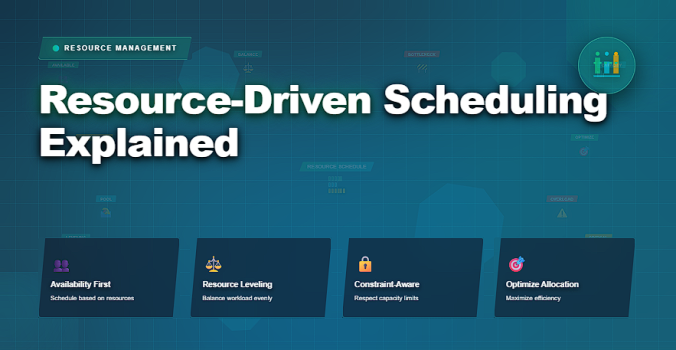
Resource-driven scheduling is an approach where resource availability and capacity determine task timing — not just dependencies or target dates.
In this model:
✔️ tasks are scheduled based on who can perform them
✔️ capacity limits are respected
✔️ overload is made visible
✔️ timelines adapt to real constraints
The schedule reflects execution reality, not planning optimism.
✅ Why Task-Driven Scheduling Often Fails
Task-driven schedules break down because they:
✔️ assume unlimited resource availability
✔️ ignore multitasking costs
✔️ overload key specialists
✔️ hide conflicts until execution
✔️ create unrealistic commitments
The result is constant re-planning, missed milestones, and team burnout.
Resource-driven scheduling fixes this by anchoring plans to what is actually possible.
✅ Core Elements of Resource-Driven Scheduling
How resources shape realistic timelines.
| Element | What It Means | Why It Matters |
|---|---|---|
| Resource Availability | When people are actually free | Prevents false start dates |
| Capacity Limits | Maximum workload per resource | Avoids overload and burnout |
| Skill Matching | Right person for the right task | Protects quality and speed |
| Resource Conflicts | Competing demands on the same person | Makes trade-offs visible |
| Schedule Adjustment | Dates move based on capacity | Creates realistic commitments |
✅ When Resource-Driven Scheduling Is Essential
This approach is especially valuable when:
✔️ resources are shared across projects
✔️ specialist skills are limited
✔️ multitasking is common
✔️ deadlines are tight
✔️ burnout risk is high
In these environments, ignoring resource constraints guarantees failure.
❌ Common Mistakes with Resource-Driven Scheduling
❌ treating availability as 100% utilization
❌ ignoring meetings and support work
❌ assigning the same expert everywhere
❌ assuming tools will fix poor data
❌ resisting date movement when capacity changes
Resource-driven scheduling fails when realism is replaced by pressure.
⭐ Benefits of Resource-Driven Scheduling
When applied consistently, it delivers:
✔️ more reliable timelines
✔️ fewer last-minute escalations
✔️ balanced workloads
✔️ improved morale
✔️ higher stakeholder trust
Realism builds confidence.
⭐ How Strong PMs Use Resource-Driven Scheduling
Strong project managers:
✔️ plan around people, not wishful dates
✔️ surface conflicts early
✔️ negotiate priorities instead of hiding overload
✔️ re-forecast regularly
✔️ protect critical resources
They understand that resources execute schedules — not charts.
⭐ Final Thoughts
Resource-driven scheduling accepts a fundamental truth:
Work cannot happen without available people.
Projects succeed not because timelines are aggressive —
but because they are aligned with real capacity.
Strong schedules are not optimistic.
They are honest, constrained, and achievable.